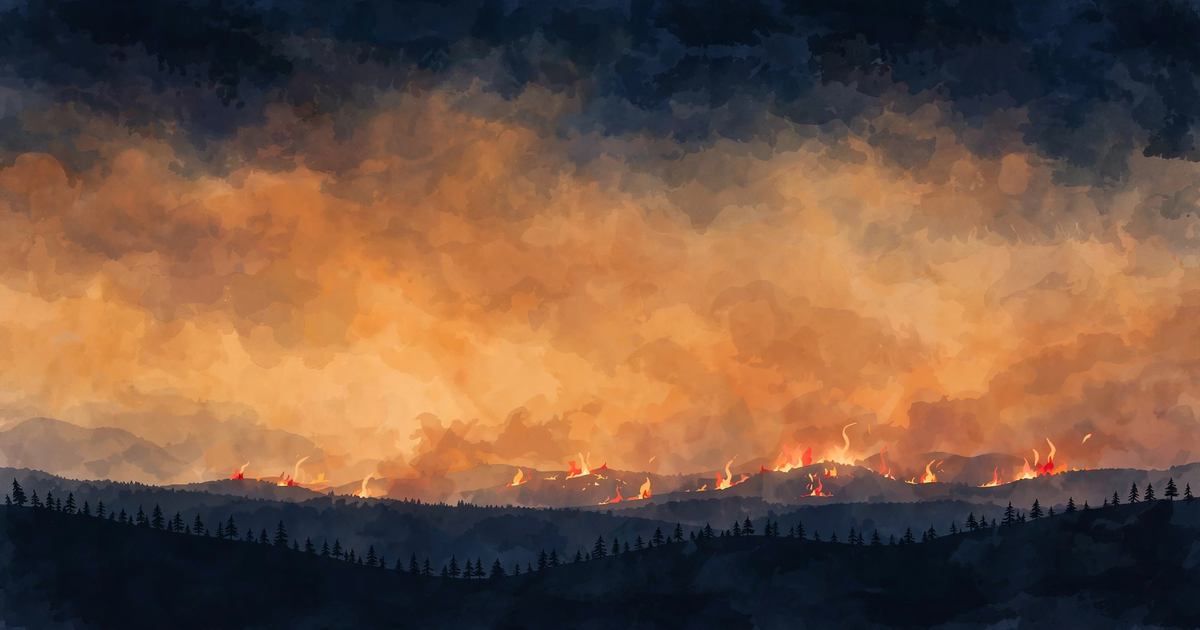
When a wildfire burns anywhere upwind, the sky can turn an eerie orange — and the danger is not only where the flames are. Smoke travels for hundreds of kilometres, settling over towns and cities that never see a single flame. The World Health Organization warns that even when you cannot smell smoke, you can still experience symptoms, because the threat is invisible: fine particles small enough to slip deep into the lungs and, from there, into the bloodstream.
Fire season is getting longer across the world, and our own live trending page currently lists wildfire as the busiest incident category of the week. You cannot stop the smoke arriving — but you can sharply reduce how much of it reaches your lungs. This guide explains what wildfire smoke is, who is most at risk, and the official steps that protect you, drawn from WHO and US Environmental Protection Agency (EPA) guidance.
Wildfire smoke and lungs: PM2.5 in plain words
Wildfire smoke is a mixture of gases and very fine particles. The particle that matters most is called PM2.5 — particulate matter 2.5 micrometres or smaller, a tiny fraction of the width of a human hair. Particles this small are not caught by your nose or throat the way coarser dust is; they travel deep into the lungs, and the smallest can cross into the bloodstream — which is why smoke irritates the lungs but also strains the heart.
The World Health Organization's air-quality guideline caps 24-hour PM2.5 exposure at 15 micrograms per cubic metre, and a serious smoke day can run far higher. Most countries publish an Air Quality Index moving through bands from green (good) and yellow (moderate), through orange (unhealthy for sensitive groups) and red (unhealthy), up to purple (very unhealthy) and maroon (hazardous). Check your local index or a source such as AirNow.gov before planning your day — and follow your local authorities' alerts first, since they hold the most up-to-date, on-the-ground information.
Who is most at risk
Smoke affects everyone who breathes it, but WHO and fire-service guidance agree on who feels it first and worst:
- Children — smaller airways and faster breathing rates mean more smoke per breath.
- Older adults — ageing lungs and hearts have less reserve to cope.
- People with asthma, chronic respiratory disease or heart conditions — smoke can trigger flare-ups and chest symptoms quickly.
- Pregnant people — WHO specifically advises them to watch for symptoms and seek medical advice early.
- Outdoor workers and firefighters — long exposure is part of the job, so protection must be deliberate.
Even outside these groups, WHO's message is blunt: if you can smell smoke, it is in the air you are breathing — reduce your exposure. And because wildfires can change direction suddenly when winds shift, stay alert for updates even on a clear-smelling day.
The clean-air room: your indoor refuge
WHO's core advice during heavy smoke is simple: stay indoors as much as possible with the doors and windows shut — unless you have been advised to evacuate. But "indoors" only helps if the indoor air is genuinely cleaner than outside. The EPA's answer is the clean-air room: one room in the home, set up to keep smoke levels as low as possible.
Pick a room with few windows and doors — a bedroom usually works. Seal the obvious gaps with a rolled towel under the door. Run a portable air cleaner with a HEPA filter in that room continuously if you have one. If you do not, the EPA recognises a widely taught low-cost backup: tape a MERV 13 (or higher) furnace filter to the back of a box fan, with the airflow arrow pointing into the fan, and run it in the sealed room. Never leave the DIY fan filter running unattended or overnight.
With central heating or cooling, set the system to recirculate so it does not pull smoky outside air in, and change the filter more often while the smoke lasts. Do not add to the problem: WHO advises cutting other indoor pollution sources during smoke events — cigarette smoke, wood or gas stoves, aerosol sprays, and frying or grilling food. Once the smoke clears, the everyday habits in our winter ventilation guide keep indoor air healthy again.
Masks: what actually works
When going outside is unavoidable, WHO's smoke guidance names one specific protection: a well-fitting FFP2 or N95 mask. Note the wording — the guidance names respirators, not cloth or surgical masks, because loose coverings let smoke-laden air leak around the edges.
Fit matters more than the mask itself: press the nose clip to your nose, check for gaps at the cheeks and chin, and remember that facial hair breaks the seal. In hot conditions WHO adds a caution — masks add physiological strain during exertion in heat, so pace any outdoor activity and take breaks. If you have heart or lung problems, check with your doctor before relying on a respirator, since breathing through one is harder work.
When to stay in — and when staying in is the wrong call
On smoky days, reduce outdoor activity — heavy breathing pulls far more particles deep into the lungs. Move exercise indoors, keep children playing inside, and postpone the gardening.
Staying indoors has one hard limit: an evacuation order always wins. Smoke guidance is for people outside the fire's path; if officials order you to leave, leave immediately. Our Norte Fire evacuation article sets out the five things to do when an order reaches you.
There is a second, quieter judgment call: heat plus smoke. The two hazards can arrive together and amplify each other. If your sealed home becomes dangerously hot, heat illness is the more immediate threat — move to the coolest room, use fans only to circulate air already inside (never fans that draw outside air in), and set air conditioning to recirculation. If you cannot keep the home both cool and clean, go somewhere that is: a friend's place, a public building with filtered air, or a community clean-air shelter. Take advantage of breaks in the smoke, like rain or a wind shift, to flush stale air out before sealing up again. Watch for burning eyes, breathing difficulty or chest pain — and get medical help promptly if they appear.
What our records show, and what they miss
Our live tracker counts fires well — wildfire is currently the most active incident category on our trending page, with thousands logged this week. What the records cannot show is the health shadow behind those numbers: the asthma flare-ups, the school days spent indoors, the outdoor shifts breathed through smoke. Official feeds record the flames, not the lungs.
That is the gap this guide fills. The tracker tells you where the fire is; the protection is in the small steps — the sealed room, the right mask, the decision to stay in — that no incident report will ever count. Browse the full articles archive for more guides alongside the live picture.
The short version
- Know your air: check the Air Quality Index and local alerts daily; if you can smell smoke, reduce your exposure, especially if you are in an at-risk group.
- Stay in, sealed up: keep doors and windows shut; make one clean-air room with a HEPA purifier or a box fan with a MERV 13 filter — never run the DIY version unattended.
- Mask right: a well-fitting FFP2 or N95 for unavoidable outdoor time — the respirators official guidance names.
- Don't add indoor smoke: skip candles, wood stoves, frying and aerosols during the event; recirculate your heating or cooling system.
- Evacuation beats everything: if officials order you out, go at once; if indoor heat becomes dangerous, cooling comes first — move somewhere cooler and cleaner.