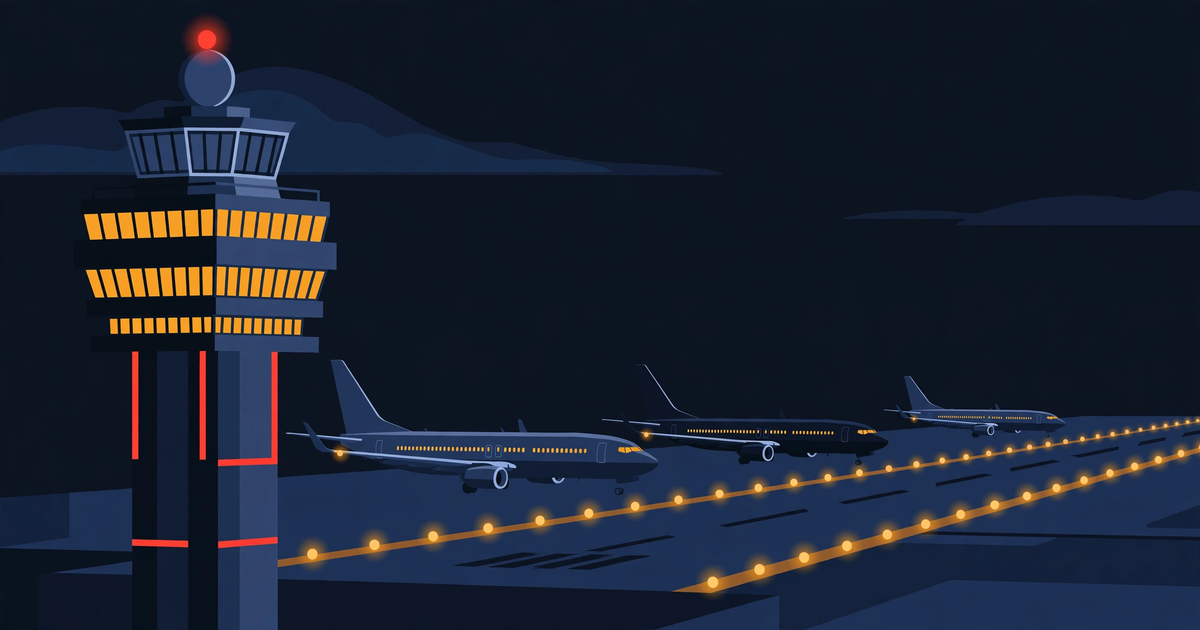
On Friday 13 November 2026, the United States stopped flying. In the afternoon, the Federal Aviation Administration (FAA) ordered a nationwide ground stop covering every airport in the country, holding all departures on the ground while flights already in the air were allowed to land. It was the first such halt since January 2023 — and only the third nationwide ground stop in American history.
The scale was enormous: more than 10,000 flights were delayed and at least 4,400 cancelled, according to FlightAware figures reported by the Associated Press and Reuters, with more than 700 further flights already cancelled for Saturday.
The stop was lifted on Friday evening, after about four hours. By then, the story was topping trending lists on X in the United States, the United Kingdom, Canada and worldwide. This article sets out what happened, what caused it, what officials have confirmed — and what is still unknown.
What the FAA ordered
The order came from the FAA's Air Traffic Control System Command Center as Advisory 111, issued at about 3:54 p.m. Eastern time. Its wording was short and stark: the ground stop applied to all airports in the United States, "due to extraordinary circumstances and for reasons of safety". A ground stop is not a closure of the skies — it holds departures. Aircraft already airborne were allowed to continue and land, but nothing new was allowed to take off anywhere in the country while the order stood.
A telecom outage across all 22 control centres
The cause was a telecommunications outage that affected all 22 of the FAA's Air Route Traffic Control Centers — the regional centres that handle aircraft flying between airports across the United States. The outage hit the links those centres rely on: the radio frequencies controllers use to speak to pilots, and the radar and data links that show controllers where aircraft are. When those links fail at all 22 centres at once, the system has no safe way to keep launching new flights.
That is why the FAA reached for its most drastic tool. A ground stop is the bluntest instrument in air traffic control: rather than managing a degraded system, it stops adding aircraft to it. Letting departures continue while controllers could not reliably see or speak to them was not an option the FAA was willing to take.
How the FAA nationwide ground stop unfolded
The sequence of the day was simple. The outage struck on Friday afternoon, and the ground stop followed at about 3:54 p.m. Eastern. For the next four hours, departures stayed on the ground while arrivals continued. Then, on Friday evening, the FAA lifted the order. Its cancellation advisory, Advisory 005, was signed at 8:19 p.m. Eastern — about four hours and 20 minutes after the stop began. Reports of the exact minute differ slightly between sources, which is why the honest figure is "about four hours".
The recovery was not instant. An aircraft that missed its departure slot does not simply take off four hours late: crews run out of legal duty hours, aircraft are in the wrong airports for their next flights, and passengers miss connections. That knock-on effect is why more than 700 flights were already cancelled for Saturday before Friday was over.
The scale of the disruption
FlightAware's figures, reported by the Associated Press and Reuters, put the disruption at more than 10,000 delayed flights and at least 4,400 cancellations on Friday alone. Because the stop covered every airport in the country, the delays were not concentrated at one hub or in one region; the backlog rippled through connecting flights across the United States and beyond.
- Nationwide ground stop: all US airports, from about 3:54 p.m. Eastern on Friday 13 November 2026.
- Cause: a telecom outage at all 22 Air Route Traffic Control Centers.
- Delayed: more than 10,000 flights. Cancelled: at least 4,400, with 700-plus more for Saturday.
- Lifted: Friday evening, after about four hours.
Why this ground stop was so rare
A nationwide ground stop is one of the rarest orders in American aviation. Friday's was only the third in the country's history. The first came on 11 September 2001, when the skies were cleared after the terrorist attacks. The second came in January 2023, when a failure of the NOTAM system — which carries safety notices to pilots — forced the FAA to halt departures. Friday's stop was the longest since 11 September 2001.
What officials have ruled out — and what is still unknown
Officials said there was no indication of a cyberattack or other malicious activity behind the outage, and that every flight had been accounted for. That matters: in the first hours of a nationwide aviation failure, the question of whether it was deliberate is the first one people ask. The cause itself, however, is still under investigation. The FAA has not yet said what failed inside the telecommunications network, or why the failure reached all 22 centres at once.
Until that investigation reports, several questions stay open. What part of the network failed, and was it a single point of failure or several at once? How long did controllers lose contact with aircraft? And what changes will the FAA make so that a single outage cannot again take down communications at every centre at the same time? None of those questions has a public answer yet.
What travellers should do
For passengers caught up in the disruption, the practical steps are straightforward. Check the flight's status with the airline before leaving for the airport, because schedules were still being rebuilt on Saturday. Keep boarding passes, receipts and any messages from the airline: they are the record of what happened to a booking if a refund or rebooking is needed later. And allow extra time — after a disruption on this scale, getting aircraft and crews back to their normal pattern takes time.
The same advice applies to anyone with a connecting flight. A cancellation on one leg can strand a passenger far from home, so it is worth confirming the whole journey — not just the first flight — before setting out. Our US airport delays tool tracks disruption as it develops, and our live map shows incidents as they are recorded.
What our records show, and what they miss
Our tracker records incidents from official sources and major news reports, and this event sits at the edge of what that record can show. The ground stop, the advisories and the cancellation figures are all matters of public record, reported by the Associated Press and Reuters and carried by outlets including weather.com and AIN. What the record cannot show yet is the cause: the investigation is still open, and the FAA has not published what failed.
Readers who want to check how we verify and label incidents can read our methodology, which explains the statuses our records carry — from officially recorded to corrected — and what each one means. Aviation incidents are tracked in our air crash records, and the latest entries appear in today's incidents.
The short version
- On Friday 13 November 2026, the FAA ordered a nationwide ground stop covering all US airports, holding every departure on the ground from about 3:54 p.m. Eastern.
- The cause was a telecommunications outage that hit all 22 Air Route Traffic Control Centers, cutting the radio frequencies and radar and data links controllers rely on.
- More than 10,000 flights were delayed and at least 4,400 were cancelled, with 700-plus more cancellations already booked for Saturday.
- The stop was lifted on Friday evening after about four hours; the cancellation advisory was signed at 8:19 p.m. Eastern.
- Officials said there was no indication of a cyberattack, and every flight was accounted for; the cause is still under investigation.