Choking or gagging? The split-second read
Choking happens when food or an object blocks the airway. It can happen at any table, in any home, at any age — and the first thing to work out is whether the person can still clear the blockage themselves.
If they can speak, cough forcefully or breathe, encourage them to keep coughing. A strong cough is the body's own way of clearing the airway, and it is often all that is needed. Stay with them, and do not interfere while the cough is strong.
Act at once if they cannot speak, cannot cough or cannot breathe, or if they are clutching at their throat or neck, going quiet, or turning blue around the lips. The steps below follow the first aid guidance of the British Red Cross, the NHS and MedlinePlus (the US National Library of Medicine's health information service), and the three sources agree on the same sequence. Call your local emergency number early, and keep going until help arrives or the blockage clears. If someone else is nearby, ask them to make the call while you start the steps.
Choking first aid for adults and children over 1
For an adult or a child over one year old, the sequence is the same.
Step 1: Encourage coughing. If they can cough at all, urge them to keep going. Only move on if the cough is weak, stops, or was never possible.
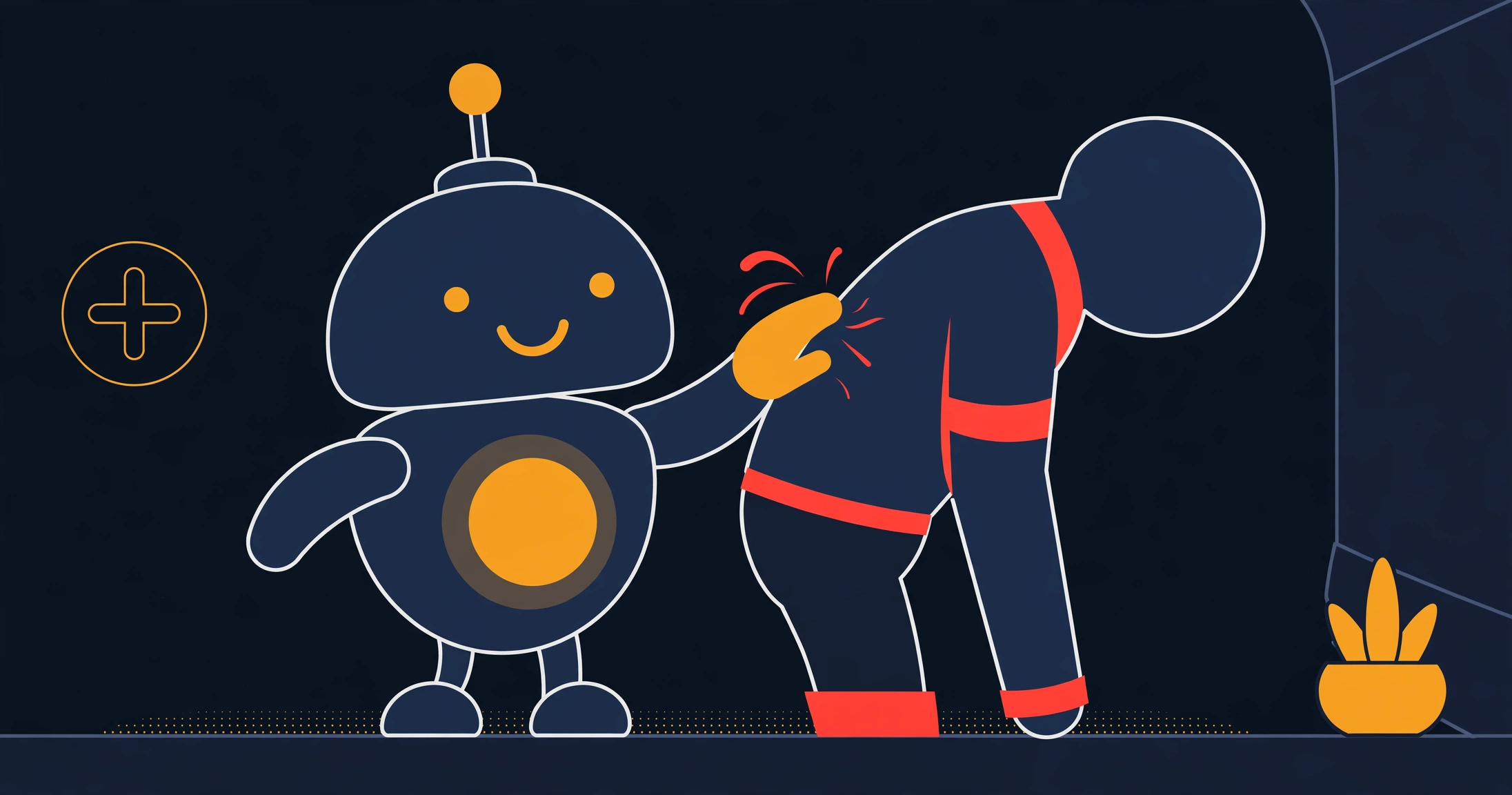
Step 2: Up to 5 back blows. Stand to the side and slightly behind them, support their chest with one hand and lean them well forward, so a loosened object can come out rather than fall further down. With the heel of your other hand, give up to five sharp blows between the shoulder blades, checking after each one.
Step 3: Up to 5 abdominal thrusts. Stand behind them, put both arms around the waist, make a fist just above the navel, thumb side in, grasp it with your other hand, and pull sharply inwards and upwards, up to five times, checking after each thrust.
Step 4: Repeat. If the blockage has not cleared, repeat the cycle — five back blows, then five abdominal thrusts — until the object comes out, help arrives, or the person becomes unconscious.
Step 5: If they become unconscious. Lower them gently to the floor, call your local emergency number if it has not been called already, and begin CPR, following the call operator's instructions.
Abdominal thrusts are powerful — which is why, after any rescue, the person should be checked by a doctor. Internal injury and secondary aspiration, where fluid or a fragment enters the lungs, are both possible even when the person feels fine.
Infants under 1: back blows and chest thrusts
A baby under one year old needs a different technique. Never give abdominal thrusts to an infant, and never do a blind finger sweep — a finger can push the object deeper.
Step 1: Up to 5 back blows. Lay the baby face down along your forearm, supporting the head and jaw, head lower than the trunk, and give up to five firm back blows between the shoulder blades with the heel of your other hand.
Step 2: Up to 5 chest thrusts. If the back blows have not cleared it, turn the baby face up along your forearm, head still lower than the trunk. Place two fingers on the centre of the chest, just below the nipple line, and give up to five sharp chest thrusts.
Step 3: Repeat and call for help. Repeat the cycle and call your local emergency number. If the airway clears but the baby is not breathing, begin infant CPR, or follow the call operator's guidance. Only remove an object you can see clearly.
Pregnant or larger people: use chest thrusts
Abdominal thrusts are not suitable for someone who is pregnant, or for a person whose body shape means you cannot get your arms around their waist. For them, use chest thrusts instead: stand behind the person, put your arms under their arms and around the chest, place a fist on the middle of the breastbone, and pull sharply backwards, up to five times, alternating with back blows. Afterwards, the person should still be checked by a doctor.
What not to do when someone is choking
A few common instincts make choking worse:
- Do not offer water or food. A drink cannot wash a solid blockage down, and liquid can enter a partly blocked airway.
- Do not do blind finger sweeps. If you cannot see the object, do not reach into the mouth — you may push it deeper.
- Do not use abdominal thrusts on an infant under 1 or on a pregnant person — use chest thrusts instead.
- Do not stop while they are coughing forcefully. A strong cough is working; only step in when it weakens or stops.
- Do not leave the person alone to go and find help. Start the steps first, and call your local emergency number as soon as you can — a phone on speaker lets you keep helping while you talk.
Prevention: the habits that stop choking before it starts
Most choking is preventable. Eat slowly, chew well, and sit down to eat rather than eating while walking or rushing. Cut food small for young children, and be careful with round, hard foods such as grapes, nuts and hard sweets, which fit a small airway all too easily.
Keep small objects — coins, buttons, batteries, small toy parts — out of reach of toddlers, who explore by putting things in their mouths. Choose age-suitable toys, check for broken pieces, and keep mealtimes calm: a child laughing, crying or running with food in their mouth is at far greater risk than one sitting and eating.
Practice it before you need it
Talk the steps through with your household. Who would call the emergency number? Answering that on a calm day means no time is lost on a bad one — the same thinking behind a family emergency communication plan.
First aid skills travel well beyond choking — the same calm approach helps with snakebite first aid, recognising heatstroke and heat exhaustion, and dangers that give little warning, such as how drowning really looks, why house-fire smoke kills first, and hypothermia and frostbite.
Choking is frightening to watch. But the response is short and the same everywhere: encourage the cough, five back blows, five abdominal thrusts, repeat, call for help, and CPR if the person becomes unconscious.
What our records show, and what they miss
Our incident records track disasters, accidents and emergencies around the world, and they show how often a sudden, ordinary moment — a meal, a journey, a day at home — turns into an emergency. What they cannot show is the quiet majority of cases that never reach the news: choking resolved at a kitchen table by someone who knew what to do, with no report filed. This guide is for those moments. It follows the published guidance of the British Red Cross, the NHS and MedlinePlus, and carries no statistics, because the steps, not the numbers, save lives.
The short version
- Strong cough? Encourage it — a forceful cough often clears the blockage on its own.
- Cannot speak, cough or breathe? Give up to 5 back blows, then up to 5 abdominal thrusts, and repeat the cycle.
- Infant under 1? Back blows on your forearm plus chest thrusts — never abdominal thrusts, never blind finger sweeps.
- Pregnant or larger person? Use chest thrusts instead of abdominal thrusts.
- Call your local emergency number early; if the person becomes unconscious, begin CPR. After any rescue, get them checked by a doctor.