When a heart stops in front of you
Picture it plainly: someone collapses in a market, on a bus, at a family gathering. Nobody around is a medic. The ambulance is minutes away, and minutes are exactly what the person's brain does not have. This is the moment the American Heart Association has spent years trying to prepare ordinary people for — because the first person on the scene of a cardiac arrest is almost never a professional. It is a bystander. It might be you.
The AHA's answer for that moment is deliberately small. It has a name — hands-only CPR — and it contains no mouth-to-mouth, no equipment, no certification. Following a witnessed cardiac arrest of a teen or an adult, the Association says, compression-only CPR can be equally effective in the first few minutes of the emergency response. The first few minutes are the ones you own. This guide is what to do with them.
Hands-only CPR in three steps
One: check, then call. Tap the person and shout — "Are you okay?" If there is no response and they are not breathing normally, call your local emergency number immediately — or point at someone specific and tell them to call, so the job does not dissolve into a crowd. If you are alone, call before you start compressions.
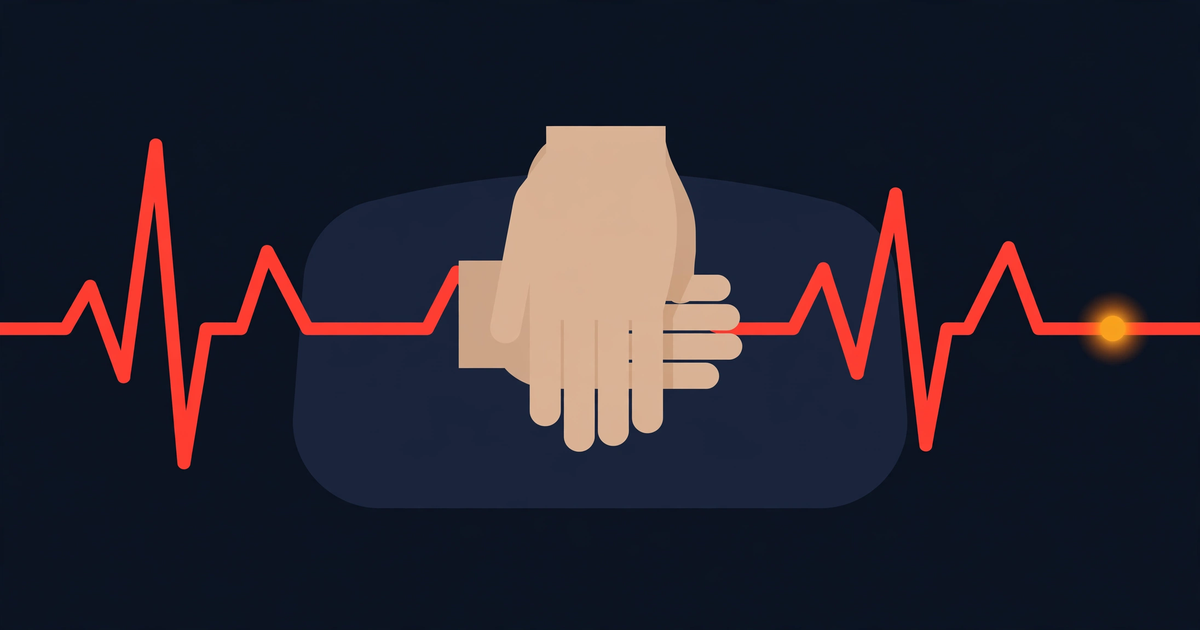
Two: hands in the center of the chest. Place the heel of one hand on the center of the chest, on the lower half of the breastbone. Put your other hand on top of the first and interlace your fingers. Keep your arms straight and position your shoulders directly over your hands, so your body weight does the work — not your arm muscles.
Three: push hard and fast, and do not stop. Compress the chest at least 2 inches (about 5 cm) deep, at a rate of 100 to 120 compressions per minute. Let the chest rise fully back up between pushes — leaning on it between compressions chokes off the blood flow you are trying to create. Minimize interruptions. Keep going until the person shows signs of life, an automated external defibrillator (AED) or trained help takes over, or you physically cannot continue.
The beat that keeps you on rate
One hundred to 120 a minute is hard to judge under stress, so the AHA gives you a metronome you already know: the beat of "Stayin' Alive" by the Bee Gees, about 103 beats per minute — squarely in the target range. The Association even built a "Don't Drop the Beat" playlist of songs at 100–120 bpm, because people trained to a familiar song hold the rate better. Pick your song now, on a calm day. In the emergency, you will not be counting — you will be humming.
Why does the rate matter? Because when an adult suddenly collapses from cardiac arrest, their blood still holds enough oxygen to sustain vital organs for several minutes. High-quality compressions manually circulate that remaining oxygen — which is exactly why, in the first minutes, compressions matter more than breaths. You are the pump while the heart cannot be.
Keep going — and let the machine talk
Two things make hands-only CPR stronger. The first is an AED: if one is nearby, send someone to get it while you start compressions, and the moment it arrives, apply it and follow its voice prompts — AEDs are built to be used by untrained people and will talk you through every step. The second is the emergency dispatcher on the phone: dispatchers can coach you through compressions in real time. Put the phone on speaker and keep pushing.
Expect it to be exhausting. Good compressions are physical work, and two minutes can feel like twenty. If another bystander is there, swap every couple of minutes without pausing the rhythm longer than you must — tired arms make shallow compressions, and shallow compressions do not move blood.
What hands-only CPR does not cover
The honest boundary of this skill matters as much as the skill itself. Hands-only CPR is for a witnessed sudden collapse of a teen or adult — the classic cardiac-arrest picture. It is not the right response for infants and children; for drowning; for a drug overdose; for breathing problems; or for someone already unconscious and not breathing normally when found.
The reason is oxygen. In children and infants, cardiac arrest is usually caused by a breathing emergency — choking, asthma, drowning — rather than a primary heart problem, so by the time the heart stops, the blood's oxygen is already spent. A drowning victim's lungs have been starved of air the same way. In those cases rescue breaths remain essential: conventional CPR alternates 30 compressions with 2 breaths, and that is what the guidelines still teach for these victims.
One rule overrides all of this: if you are untrained in or unwilling to give breaths, compressions alone are still far better than doing nothing. The AHA is explicit that continuous hands-only CPR is acceptable in that situation. A imperfect rescue beats a perfect hesitation.
The fear of doing it wrong
Most people freeze not from indifference but from doubt: what if I hurt them, what if I do it wrong? The AHA's own surveys found roughly seven in ten people in the US feel powerless to act in a cardiac emergency — and that powerlessness is the real killer, because the Association also says effective bystander CPR can double or even triple a victim's chance of survival.
Here is the reframe worth carrying: a person in cardiac arrest is already at the worst possible outcome. You cannot make death worse. Broken ribs heal; a stopped heart does not restart itself. Hands-only CPR asks nothing of you except the decision to start — and the Association built it that way on purpose, so that the 7 in 10 become the 3 in 10 who act.
What our records show, and what they miss
Our incident records hold cardiac arrests the way they hold every disaster: the event, the place, the outcome filed. What they show is how ordinary the settings are — a street, a shop, a stadium seat. What they miss is the part nobody reports: the bystander who called the emergency number first, the stranger who pushed hard and fast to a song in their head, the AED cabinet that got opened instead of walked past. Nobody files an incident report for compressions that kept blood moving until the ambulance arrived. Learn the three steps on a calm day — call, hands center, push to the beat — and you join the majority our records never see.
The short version
- Witnessed teen/adult collapse: tap and shout, call your local emergency number, then start compressions.
- Hands-only CPR = compressions only: heel of hand on the center of the chest (lower half of breastbone), arms straight, shoulders over hands.
- Push hard and fast: 100–120 compressions a minute, at least 2 inches (5 cm) deep — "Stayin' Alive" pace. Full chest recoil, minimal pauses.
- Send someone for an AED; apply it when it arrives and follow its voice prompts — and keep pushing until signs of life, trained help takes over, or you cannot continue. Keep the dispatcher on speaker.
- Not for infants/children, drowning, overdose, or breathing emergencies — those need rescue breaths (30 compressions : 2 breaths). But compressions alone still beat doing nothing.