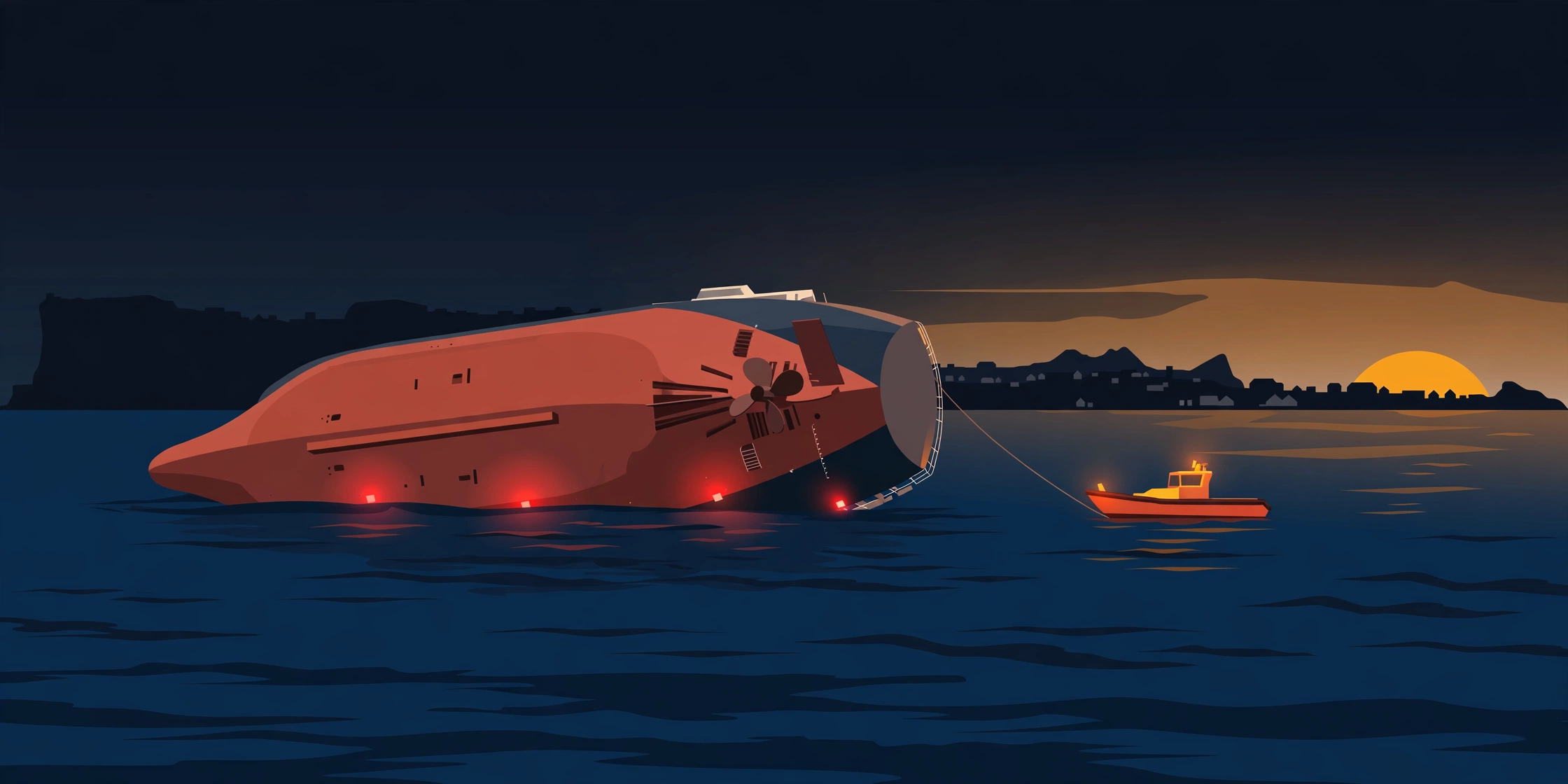
A diesel tanker capsized off Ibiza on Wednesday night, 25 November 2026, with about 7,000 tonnes of diesel on board. One crew member died. The other 17 were rescued. And as of Friday morning, the ship was still afloat — upside down, partly submerged, stabilised by a tow line from Spain's pollution-control vessel, and drifting in the Mediterranean with its cargo tanks, for now, intact.
That last detail is the one that matters most. The Med Emre is not a wreck on the seabed. It is a capsized tanker, floating on its side, carrying a cargo that could do serious harm to one of the most protected stretches of water in the Mediterranean if the tanks fail. The rescue is over. The salvage and the watching have only just begun.
What happened on Wednesday night
The Med Emre is a Malta-flagged chemical tanker that was sailing from Algeciras to Barcelona when it sent a Mayday call at about 22:30 local time on Wednesday 25 November. Six minutes later, the crew reported water entering the hull and the ship listing at about 90 degrees. Contact was lost around midnight.
A Salvamento Marítimo aircraft found the vessel on Thursday morning, at 09:26, upside down and still afloat, around 19 miles north-west of Ibiza. The BBC put the position at about 25 nautical miles — 46 kilometres — from Ibiza's coastline, and 57 nautical miles from Valencia. The two figures describe the same drifting wreck at different times: a capsized ship does not stay where it turned over.
All 17 crew members were rescued from the water. Seven were taken to hospital. One of them, taken to Can Misses Hospital in Ibiza, was later pronounced dead. The other six were treated for minor injuries, mainly hypothermia. Five crew members were transferred to Valencia, while five remained aboard a rescue vessel. No names have been released, and none are used here.
The diesel on board
The Med Emre was carrying up to 7,000 tonnes of diesel. That is the figure the BBC and Euro Weekly News both report, and it is worth putting in context. It is a large cargo for a ship of this size, and it is the reason the response was so fast and so large. But it is also, for now, still in its tanks.
By Thursday afternoon, a small oily sheen stretching 2.6 miles had been spotted near the wreck. The maritime authority, Capitanía Marítima, said the ship's cargo and fuel tanks remained intact and the sheen had not grown. Officials believe the oily material may be residue already on board the vessel, rather than diesel escaping from the cargo tanks. That is a careful distinction, and it matters: a sheen from residue is a clean-up problem; a leak from the cargo tanks would be an environmental emergency.
By Friday morning the picture had improved further. Reconnaissance flights confirmed that the sheen had degraded and evaporated completely, and the cargo tanks were apparently intact, with no contamination in the area, according to the Balearic newspaper ARA Balears. The pollution-control vessel Clara Campoamor had also managed to attach a tow line to the Med Emre, stabilising the capsized ship about 16 miles north-west of Ibiza and curbing its drift. None of that removes the risk — a capsized tanker under tow is still an unstable object — but the worst early fear, a spreading diesel slick, has not materialised.
The ship's owner was first given three hours to present a plan for dealing with the vessel, including whether to remove its cargo first or tow it first. That is a hard choice. Towing a capsized tanker risks stressing the hull and the tanks. Removing the cargo at sea — lightering it into another vessel — is slow and needs calm water. A preliminary plan has now been submitted and is under review, as described below.
The plans Spain activated
Spain activated its National Maritime Plan at level two. The Balearic government activated its PLATERBAL civil protection plan at level zero, and the national government also activated Plan Ribera as a precaution. These plans coordinate the response and let teams monitor the risk. They do not mean that diesel has been confirmed leaking from the cargo tanks — and that distinction is worth keeping in mind as the story develops.
On the water, the possible environmental damage is being assessed by a plane and by Spain's pollution-control vessel, and the area is monitored for any new sheen. The maritime captain of Valencia, Elena Delgado, told the AFP news agency on Thursday that a small slick had formed and then disappeared, and that "the situation is stabilised".
On land, life carried on. Ibiza port and ferry services were operating normally on Thursday, and local reporting said no beaches had been closed. That is the honest picture at this stage: a serious incident at sea, and a normal day on shore. Residents and visitors should follow any new advice from the authorities while the wreck is monitored, rather than relying on rumours or on pictures of the wreck.
Why Ibiza's waters matter
Ibiza is not just a holiday island. Its marine environment has been on UNESCO's World Heritage list since 1999, and the reason is the seagrass Posidonia oceanica, which grows in dense meadows around the island. Those meadows are nurseries for fish, they hold the seabed together, and they are slow to recover when they are damaged. Diesel does not have to reach a beach to do harm: it can smother seagrass, coat the animals that live in it, and linger in sheltered coves.
That is why the authorities are watching a sheen of 2.6 miles so closely, even while the tanks are intact. A small amount of diesel, in the wrong place, can do a lot of damage to a protected marine environment. And it is why the comparison that many people will reach for — the Prestige — is both understandable and, for now, misleading.
The Prestige, and why this is different
In 2002, the Prestige sank off the coast of Galicia carrying more than 60,000 tonnes of heavy fuel oil, in what became Spain's worst environmental disaster. The oil spread along the coast, killed wildlife, and closed fisheries. It is the disaster that shaped Spain's maritime pollution plans, including the ones activated this week. Tanker incidents have made the news twice more this week alone: a fuel tanker fire on Cairo's ring road and an explosion at Bangkok's Bangchak refinery.
But the Med Emre is not the Prestige, at least not yet. The cargo is diesel, not heavy fuel oil, and diesel breaks down and disperses far more quickly in seawater. The load is about 7,000 tonnes, not more than 60,000. And, crucially, the tanks are still intact and the ship is still afloat. The plans that the Prestige taught Spain to write are now being used in the way they were meant to be used: early, and before the worst happens.
None of that is a promise. A capsized ship in open water is unstable, and weather can change the picture in hours. But it is worth being clear about what has actually happened so far — one death, a capsized tanker, a small sheen, and a large, organised response — rather than assuming the worst from the name of the cargo alone.
What happens next
The next steps belong to the ship's owner and to the Spanish authorities. The Turkish shipping company has now presented a preliminary salvage plan, which the maritime administration is analysing before it can be authorised by the Directorate General of the Merchant Navy. A technical inspection is planned for Saturday morning, with divers and specialists from Salvamento Marítimo's Cartagena base and technicians from the shipowner, to inspect the visible hull and the submerged part, check the structural condition of the vessel and measure its actual draft.
The order of operations is settled in principle, even if the details are not. The absolute priority, in the words of the maritime captain of Valencia, Elena Delgado, is to guarantee the buoyancy and stability of the vessel. Once that is assured and it is verified that there are no leaks, the towing to a port or place of refuge will be addressed — a destination the shipowner must propose and the Merchant Navy must approve — and only there is the extraction of the diesel from the cargo tanks and the fuel from the ship itself planned.
There are also questions that will take longer to answer. Why did water enter the hull so quickly after the Mayday call? What caused the list to reach 90 degrees in minutes? The captain of the Med Emre has pointed to a massive ingress of water into the ballast tanks on one side, in bad weather with waves of up to four metres, according to ARA Balears. That is a hypothesis from the bridge, not a finding: the captain remains at the disposal of the judicial authorities and the maritime accident investigation commission, and the cause should not be treated as settled until that investigation reports.
For now, the facts are these: a tanker capsized off Ibiza on Wednesday night; one crew member died and 17 were rescued; about 7,000 tonnes of diesel are still in the tanks; the sheen spotted on Thursday has disappeared; and Spain's pollution plans are running. If the tanks hold and the cargo is removed safely, this will be remembered as a rescue and a warning. If they do not, it will be remembered as something else entirely.
What our records show, and what they miss
What our records show is a story on which the main sources agree. The BBC, Reuters, Al Jazeera and Euro Weekly News all report the same core facts: a Malta-flagged tanker, sailing from Algeciras to Barcelona, sent a Mayday late on Wednesday 25 November, listed sharply and capsized, with 17 crew rescued and one dead. Spain's response is documented the same way in every account — the National Maritime Plan at level two, the Balearic PLATERBAL plan at level zero, the Clara Campoamor on station — and the Friday-morning updates from ARA Balears and the shipping press line up with them: the sheen gone, the tow line attached, the tanks apparently intact, a preliminary salvage plan submitted.
Where the records differ, the differences are small and explainable. The reported distance from Ibiza ranges from about 16 to about 30 nautical miles, and the Mayday time is given as 21:30 in one account and about 22:30 in another. A capsized ship drifts, and early reports are taken at different hours; neither discrepancy changes the story. Our own incident records carry no earlier entry for the Med Emre, and this is the first article on the site about the incident, so there is no prior coverage to reconcile against.
What the records miss is more important. No authority has yet confirmed why the ship capsized: the ballast-tank explanation comes from the captain, and the investigation commission has not reported. The salvage plan is preliminary and unauthorised, the divers' inspection is still to come, and no port of refuge has been named. Most of all, the central question — will the 7,000 tonnes of diesel stay in the tanks until they can be emptied? — is still unanswered. Every reassuring fact in this article is a snapshot from Friday morning. A capsized tanker in open water can change that picture in hours, and the next update, not this one, is the one that will tell us whether the rescue stays a rescue.
The short version
- The Malta-flagged tanker Med Emre capsized off Ibiza on Wednesday 25 November 2026 while sailing from Algeciras to Barcelona, carrying about 7,000 tonnes of diesel.
- One crew member died; the other 17 were rescued. Six were treated in hospital for minor injuries, mainly hypothermia.
- The ship was found upside down and still afloat on Thursday morning, about 25 nautical miles (46 km) from Ibiza's coastline, according to the BBC. By Friday morning it was stabilised by a tow line about 16 miles north-west of Ibiza.
- A small oily sheen 2.6 miles long was spotted near the wreck on Thursday, but reconnaissance flights confirmed on Friday morning that it had degraded and evaporated completely, with the cargo and fuel tanks apparently intact and no contamination in the area.
- The shipowner has presented a preliminary salvage plan, which the maritime administration is reviewing; divers will inspect the hull on Saturday morning before any tow to a port of refuge.
- Spain activated its National Maritime Plan at level two, and the Balearic government activated its PLATERBAL plan at level zero, as a precaution.
- Ibiza's marine environment is on UNESCO's World Heritage list, largely because of its Posidonia oceanica seagrass meadows.
- Watch the Spanish maritime authorities for updates on the salvage plan and on whether the tanks hold.