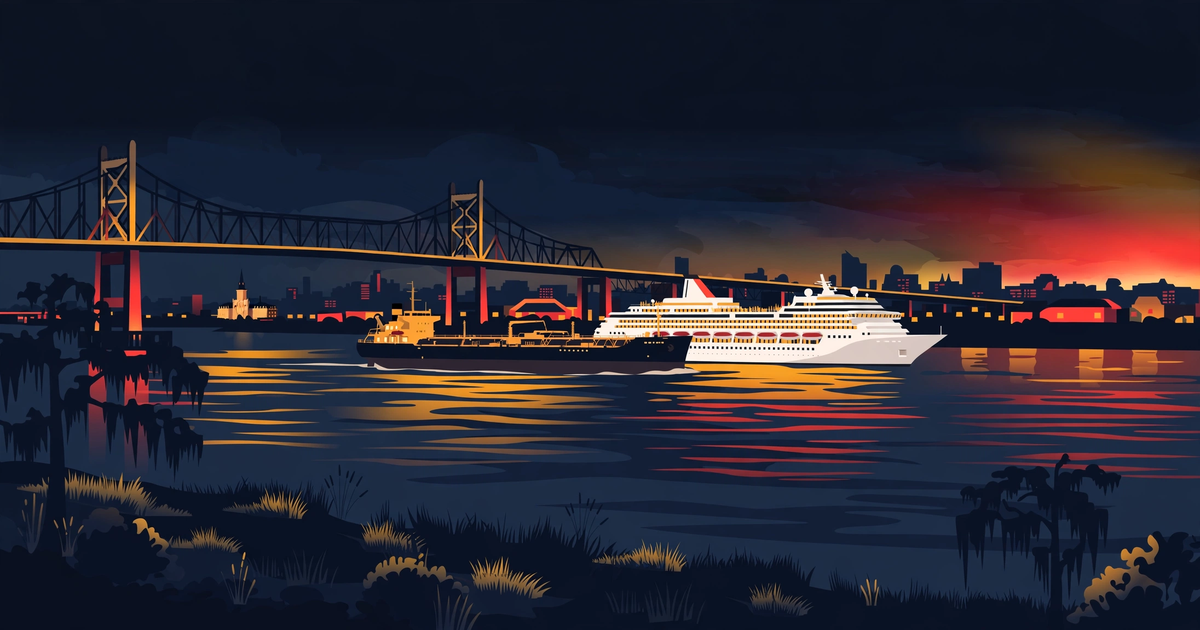
On Friday 13 November 2026, a tanker struck a docked river cruise ship on the Mississippi River in New Orleans. The cruise ship, the American Heritage, was carrying about 129 passengers, along with its crew, when the tanker Atlantic Asphalt hit it at about 12.30pm local time near the Crescent City Connection. As passengers left the vessel, it listed and toppled over, sending several people into the water. Thirty-two people were taken to hospital. None was critically injured, and every person on board was accounted for.
New Orleans Mayor Helena Moreno called the outcome "a miracle on the Mississippi". The United States Coast Guard closed the river to all vessel traffic between mile markers 93 and 96 while responders worked at the scene, and ferry services across the river were suspended for a time.
The collision happened on the same day that a nationwide ground stop halted flights across the United States after a telecom outage, and the disruption reached into this rescue too: the National Transportation Safety Board's travel to New Orleans was delayed because flights had been grounded. Our report on the FAA ground stop explains what happened.
What happened on the river
The American Heritage is a paddlewheel riverboat operated by American Cruise Lines, with room for about 150 guests. It had been due to leave New Orleans for Baton Rouge on a multi-day cruise when the collision happened. Video from the scene showed the Atlantic Asphalt striking the riverboat while it appeared to be docked, close to the Port of New Orleans Administration Building at 1350 Port of New Orleans Place.
Mayor Moreno said at a press conference that the tanker had lost control on the river before it crashed into the cruise ship. The Port of New Orleans said the cause of the collision had not yet been confirmed.
About 129 passengers were on board, along with the crew. The mayor put the total number of people on the ship at around 180 to 190. The boat was carrying mostly older passengers, according to Louisiana Lieutenant Governor Billy Nungesser.
After the impact, passengers began to leave the vessel. While they were doing so, the American Heritage began to capsize and eventually toppled over. People were seen in the river wearing life jackets, and others stood near the railing as the far side of the boat sank lower into the water. Being in the water after a boat capsizes is dangerous even for strong swimmers, as our guide to why being able to swim barely helps when a boat capsizes explains.
The Mississippi River tanker collision: rescue on the water
Port NOLA Harbor Police, the New Orleans Fire Department, the New Orleans Police Department and the US Coast Guard all responded. The historic riverboat Creole Queen picked at least 14 people out of the water. Others were brought ashore and taken inside the Port of New Orleans Administration Building.
Thirty-two people from the riverboat were taken to local hospitals. LCMC Health said it was treating 32 injured passengers at University Medical Center New Orleans and other LCMC Health hospitals. The mayor said none of them was critically injured. No one was killed, and by the evening every passenger had been accounted for.
The river was cold enough to be a danger in itself. Its temperature was about 66 degrees Fahrenheit, and forecasters warned that mild hypothermia was a risk for anyone who had spent time in the water. Our guide to hypothermia and frostbite explains the warning signs to watch for.
Louisiana's lieutenant governor secured 85 hotel rooms for passengers affected by the collision, and American Red Cross volunteers from the Louisiana Region were on the ground supporting cruise guests and their families. A helpline was set up through the city's 3-1-1 service for anyone who could not reach a loved one. For people displaced by a disaster, our guide to food and water safety after a disaster covers the basics.
Anyone who sees a person struggling in the water should know that drowning is silent, and our water safety rules explain what to do — and what not to do — before help arrives.
How the river was closed, and when ferries returned
The Coast Guard closed the Mississippi River to all vessel traffic between mile markers 93 and 96 while responders assessed the scene and worked out how to deal with the damaged vessels. The Regional Transit Authority suspended its ferry service across the river as a precaution, then reopened it. A portion of the river remained closed by the Coast Guard at the latest update.
The closure mattered beyond the rescue itself. The Mississippi at New Orleans is one of the busiest stretches of inland waterway in the United States, and even a short closure forces cargo and passenger traffic to wait or divert.
What happens next: the investigation
The National Transportation Safety Board is expected to investigate the collision, but its investigators' travel to New Orleans was delayed by the nationwide grounding of flights on the same day. Congressman Troy Carter said the ground stop was affecting the board's ability to respond.
Until the investigation reports, the key question — why the tanker lost control — has no confirmed answer. The Port of New Orleans said the cause had not yet been confirmed, and the Coast Guard's river closure stayed in place while the scene was assessed. President Donald Trump was briefed on the collision, and Louisiana Governor Jeff Landry travelled to New Orleans as the response continued. Tankers have been involved in other serious incidents this year, including a tanker fire in Lagos in October, in which two people were hurt.
What our records show, and what they miss
Our records show the collision, the rescue and the river closure as they were reported on 13 November 2026: the time and place, the two vessels, the 32 people taken to hospital, and the fact that everyone on board was accounted for. What they do not show is why the tanker lost control, how long the river closure will last, or the full condition of the American Heritage after it toppled over. Those details depend on the Coast Guard and the National Transportation Safety Board, and they will change as the investigation proceeds. We will update this article when officials confirm more.
The short version
- A tanker, the Atlantic Asphalt, struck the docked cruise ship American Heritage on the Mississippi River in New Orleans at about 12.30pm on Friday 13 November 2026.
- The cruise ship toppled over as passengers disembarked; several people went into the water and at least 14 were rescued by the riverboat Creole Queen.
- Thirty-two people were taken to hospital, none critically injured; all passengers and crew were accounted for and no one was killed.
- The Coast Guard closed the river between mile markers 93 and 96, and ferry services were suspended for a time before reopening.
- The cause has not been confirmed, and the National Transportation Safety Board's travel to the scene was delayed by the same day's nationwide flight ground stop.