The five minutes that matter most
On Saturday 24 October, a shallow earthquake struck offshore near Vanuatu. It was first reported at magnitude 7.2 and later revised to magnitude 6.9, at a depth of 10 kilometres, roughly 200 kilometres west of Sola. The Pacific Tsunami Warning Center issued a tsunami warning for coasts within 300 kilometres of the epicentre. The threat was later declared over, and no casualties or significant damage had been reported.
That sequence is exactly why this guide exists. The warning system worked, and in this case there was no wave to fear. But a warning centre cannot always reach you in time, and a local tsunami can arrive within minutes of the shaking. The decisions that protect you are the ones you make before any siren sounds and before you know whether a wave is coming at all.
The rule is simple: if you are on the coast and you feel a strong earthquake, do not wait to be told to move. Move.
Tsunami safety: during the shaking
When the ground starts shaking, protect yourself first. Drop to the ground, take cover under a sturdy table or desk if one is close, and hold on until the shaking stops. Do not run outside while the ground is still moving; falling debris and breaking glass are the immediate danger.
If you are outdoors, move away from buildings, trees, street lights and power lines, and drop and cover your head and neck. If you are driving, pull over to a clear area away from bridges and overpasses, stop, and stay inside the vehicle until the shaking stops.
Tsunami safety: the natural warnings
Official warnings save lives, but nature gives its own warnings first, and they need no technology at all. Learn to recognise them, because they are the signal to evacuate immediately:
- Shaking so strong or long that you cannot stand up, or shaking that lasts for a minute or more. A long, rolling quake on the coast is the classic sign of a tsunami earthquake.
- The sea suddenly pulling back, exposing the seabed, or suddenly rising higher than normal. A rapid change in sea level after an earthquake means a wave may already be on its way.
- A loud roar coming from the ocean, sometimes described as sounding like a jet engine or a freight train. If you hear it after coastal shaking, do not go to the shore to look.
Any one of these signs, on its own, is enough. You do not need all three, and you do not need confirmation from anyone else. If you feel a strong coastal earthquake, treat the shaking itself as the warning.
Move immediately to high ground
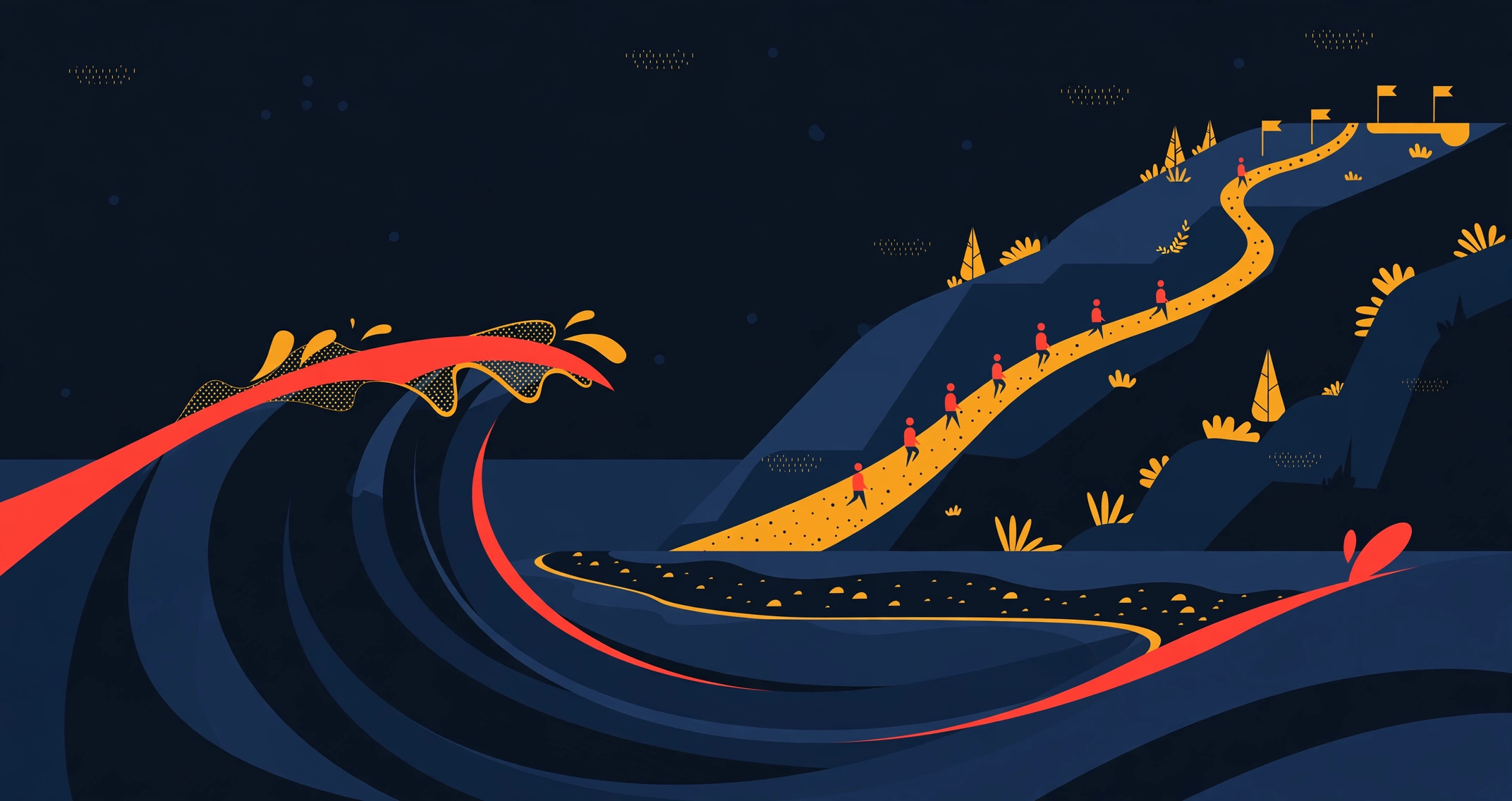
As soon as the shaking stops, move to high ground on foot. Head for ground at least 50 feet, or 15 metres, above sea level, or at least a mile inland. Leave everything behind: possessions can be replaced.
Go on foot whenever you can. Roads near the coast can jam, crack or flood within minutes, and a car stuck in traffic on a low coastal road is a trap, not an escape. Do not stop to film the sea. If you can see the wave, you have waited too long.
Cascadia-type modelling puts some coastal arrivals as soon as around 25 minutes after the quake — an illustration, not a forecast for any particular coast. The only safe assumption is that you may have minutes, not hours.
If you cannot reach high ground
Sometimes high ground is too far away, or the route to it is blocked. In that case, go up, not out. Move to the third floor or higher of a tall, reinforced-concrete building and stay there. Height is what protects you.
If no such building is available, climb a sturdy tree as a last resort. If you are in a boat at sea, head out to deeper water; never bring a boat back towards shore to check on property.
Stay out until the all-clear
Reaching safety is only half the task. A tsunami is not a single wave: it is a series of waves that can continue for hours, and the first wave is rarely the largest. Do not return to the shore between waves.
Stay out of the hazard zone until local officials give the all-clear. Note the distinction carefully: a warning centre may cancel its bulletin while danger remains near the shore, because its bulletin covers a wide region. Until local officials say it is safe, treat the coast as closed.
After the water recedes
When the all-clear finally comes, the dangers are not over. Stay out of floodwater: it can hide debris and open drains, it can be contaminated, and it can carry live electricity from downed power lines. Never touch electrical equipment while standing in water.
Do not enter buildings damaged by water or shaking until they have been checked, and watch for gas leaks, broken pipes and unstable walls. Check on neighbours and family by text message or social media rather than by phone call, so voice networks stay free for emergencies. Photograph damage for insurance only once it is safe to do so.
Prepare before you need it
None of this should be worked out for the first time while the ground is moving. If you live on, work on or regularly visit a coast, learn your evacuation route and your assembly point in advance. Many coastal areas publish tsunami hazard maps showing which streets are at risk; find yours before you need it.
Keep a go-bag by the door with water, food, medicines you rely on, documents, a torch and a phone charger, and make sure everyone in your household knows the plan: where to go, how to get there on foot, and where to meet if you are separated. Practise once. The same household planning helps with family emergency communication, landslide safety, choking first aid and winter power outage preparation.
October 2026 has already shown how often these alerts fire. The Panama earthquake of 9 October, at magnitude 7.6, produced a Pacific tsunami threat bulletin for nine countries before it was lifted. On 23 October, an earthquake swarm in Italy's Aeolian Islands tripped an automated warning that evacuated schools in Sicily, and no wave arrived. Warnings that end without a wave are not false alarms to ignore next time; they are the system working.
What our records show, and what they miss
Our records track incidents as they are reported, and tsunami warnings appear in them as official bulletins with epicentres, magnitudes and warning areas. The pattern is clear: offshore quakes trigger warnings, most are lifted without a damaging wave, and the areas named in a bulletin must act first.
What they miss is just as important. A record of a warning tells you nothing about whether people on a particular beach heard it, whether the road to high ground was passable, or whether anyone waited for confirmation that never came. A database can tell you that a warning was issued; only preparation decides what happens next.
The short version
- During coastal shaking: Drop, Cover, Hold On, and do not run outside until the shaking stops.
- After the shaking: do not wait for a siren or an official order. Strong, long shaking, a sudden change in sea level, or a roar from the ocean each mean evacuate now.
- Move on foot to ground at least 50 feet above sea level or a mile inland, leaving everything behind.
- If high ground is out of reach, go to the third floor or higher of a tall reinforced-concrete building.
- Stay out of the hazard zone until local officials give the all-clear: tsunamis arrive as a series of waves over hours, and the first is rarely the largest.