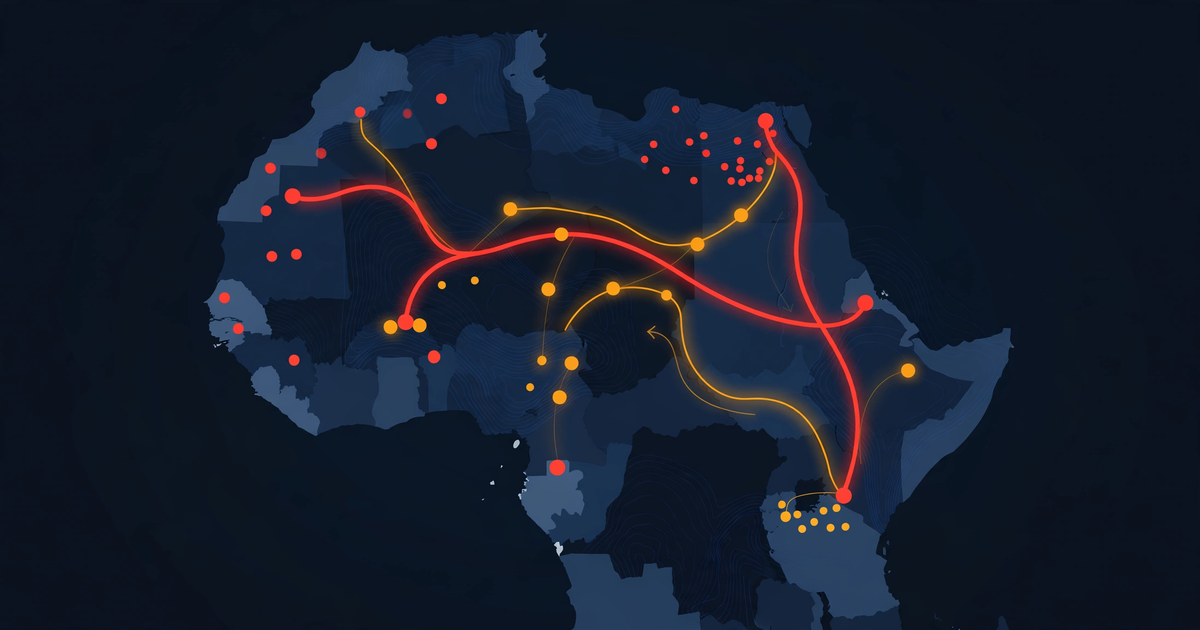
Congo's Ebola outbreak has passed 12,000 confirmed cases. Government data reported on 26 November put the total at 12,021 confirmed cases and 5,917 deaths, according to the Associated Press. That makes it the second-largest Ebola outbreak ever recorded, and the fastest-growing one. The question is whether health workers can reach the places where it is spreading fastest.
Three days earlier, the US Centers for Disease Control and Prevention (CDC) counted 11,986 confirmed cases and 5,871 deaths as of 23 November. The gap is three days of growth in an outbreak moving quicker than any before it. Nearly half of confirmed cases have died — close to the WHO's average fatality rate of around 50%.
What the latest Congo Ebola outbreak numbers actually mean
Set the 12,000 figure beside the only outbreak bigger than this one. West Africa in 2014–2016 recorded more than 28,000 cases and 11,300 deaths, according to the Associated Press, most of them in Liberia, Guinea and Sierra Leone. Congo is now well past a third of that total, reached in months rather than years. The CDC says this outbreak passed 1,000 confirmed cases within 40 days of the response starting; the 2018 outbreak in Congo took about 235 days to reach the same point. Speed matters because every new case means a list of contacts to find, watch and, where possible, vaccinate early — and when cases double quickly, the list grows faster than teams can work through it. It is also the CDC's 17th Ebola outbreak in Congo.
Why Beni is the centre of this outbreak
More than 8,000 of the confirmed cases have been reported in Beni, a city in North Kivu province near the border with Uganda, according to the Associated Press. Cases there have almost tripled in the last five weeks, according to Médecins Sans Frontières (MSF), and more than 6,200 cases were reported across the outbreak in that same five-week stretch. Beni is a busy, crowded trading town — exactly what a virus like this needs.
Cases are confirmed in five provinces, but the weight of the outbreak sits in the east. South Kivu has reported no confirmed cases since 29 May, according to the CDC, which suggests the response there has held, at least for now. The worry is the opposite direction: people fleeing fighting carry the virus with them, sometimes without knowing it. Cases have already crossed borders — nine in Kenya, one in Nigeria, 21 in Uganda, one in France — with no community spread beyond the region.
The virus itself, and what it does to people
The CDC says this outbreak is caused by Bundibugyo virus, one of the viruses that cause Ebola disease. People catch it through direct contact with the blood or body fluids of someone sick or dead, or with contaminated objects and surfaces, according to the WHO; burial ceremonies that involve touching the body can also spread it. People cannot pass it on before they have symptoms.
Symptoms usually begin two to 21 days after infection, according to the WHO: fever, fatigue, muscle pain, headache and a sore throat, then vomiting, diarrhoea and a rash. Without early, intensive supportive care, the illness often kills within days; with that care, survival improves. There are approved vaccines and treatments for Ebola virus disease — the WHO names Ervebo and the Zabdeno/Mvabea combination — but, according to the WHO, there is no approved vaccine or treatment for Bundibugyo virus disease.
Why the response is struggling: fighting, trust and distance
The outbreak is unfolding in a war zone. Fighting between the Congolese army and M23 rebels has gone on since January, according to the Associated Press, and the rebels have captured the cities of Goma and Bukavu. Health workers have been forced out of Rutshuru, Lubero, Masisi and Walikale in North Kivu, and Fizi, Uvira, Mwenga and Shabunda in South Kivu.
The cost to health workers is stark. More than 800 have been infected and 460 have died as of 14 November, according to MSF. Every infected nurse or contact tracer is one fewer person doing the work, and it feeds the fear that keeps people away from clinics. The WHO declared a global health emergency on 16 September, according to the Associated Press. Then there is trust: where clinics have closed and promises have failed, a team in protective suits taking a sick relative away can look like a threat, not a rescue.
Vaccines: what exists, and what does not
Gavi, the Vaccine Alliance, has delivered 1.5 million doses of vaccine, according to the Associated Press, and the WHO has said 6 million doses will be needed in the next six months. The vaccines that are available are being used in ring vaccination — vaccinating the contacts of a case, and the contacts of those contacts — which works only if contacts are found quickly. Supportive care remains the main treatment for this virus: fluids, oxygen where needed, and treatment of symptoms as they come.
What it means for travellers and for the UK, US and Europe
For most people in the UK, the US or Europe, the direct risk is low. The CDC says no cases have been confirmed in the United States and the overall risk to the American public and travellers remains low. The CDC advises against all travel to Ituri and North Kivu provinces, and against non-essential travel to Haut-Uele and Tshopo, and asks travellers from the affected areas to watch for symptoms for 21 days after leaving. Anyone who has been in the area and develops a fever should seek medical care at once and say where they have been.
What our records show, and what they miss
Our own records, like most public trackers, are good at the shape of an outbreak and poor at its texture. We can show the curve — 1,000 cases in 40 days, 12,000 in a matter of months — and the geography, with Beni carrying more than two-thirds of the load. What we cannot show is what the curve feels like on the ground: cases never reported because a family buries a relative at home, contacts missed because a road is closed by fighting, clinics that stopped reporting because their staff fled. Official counts are the floor, not the ceiling — and in a conflict zone the gap is probably wide.
Treat every total as a minimum — and ask who counted it, and who could not be counted.
The short version
- Congo's Ebola outbreak has passed 12,000 confirmed cases and 5,917 deaths, according to DRC government data reported on 26 November — the second-largest Ebola outbreak on record.
- It reached 1,000 cases in 40 days — the fastest growth on record — and is caused by Bundibugyo virus, for which there is no approved vaccine or treatment, according to the CDC and WHO.
- Beni carries more than 8,000 cases, and fighting has forced health workers out of several districts.
- More than 800 health workers have been infected and 460 have died, according to MSF; 6 million vaccine doses will be needed in the next six months, according to the WHO.
- The risk to the public in the UK, US and Europe remains low, according to the CDC, but travellers should avoid Ituri and North Kivu and watch for symptoms for 21 days after leaving the area.
Sources: CDC — Ebola Outbreak: Current Situation; WHO — Ebola disease fact sheet; Associated Press — Ebola outbreak in Congo reaches 12,000 cases.