The prettiest fire risk in the house
Festival season changes a home overnight. Strings of lights go up along the windows, the tree or the balcony goes in the corner, candles come out for the table, and extension cords snake across rooms that were never wired for a celebration. It looks beautiful — and it is also the one week of the year when an ordinary living room quietly collects the ingredients of a house fire: old wiring, overloaded outlets, dry greenery and open flame.
The pattern is consistent enough that the safety agencies measure it. The National Fire Protection Association's figures for the United States put home Christmas-tree fires at an average of 143 a year in 2020–2024, causing about 7 deaths, 13 injuries and roughly $15 million in property damage — and electrical distribution and lighting equipment was involved in 44% of them, with a heat source too close to the tree in about one in four. The Electrical Safety Foundation International adds the other half of the picture: 45% of home decoration fires are sparked by candles, and December is the peak month for candle fires. None of this is about bad luck. It is about a handful of checks that take minutes and that most people skip because the lights worked fine last year.
Before you plug anything in: the five-minute inspection
Start on the floor, before a single strand goes up. The Electrical Safety Foundation International's first rule of holiday decorating is to inspect every light set, decoration and extension cord before use — because a year in storage is exactly how wires get damaged. Look for frayed or cracked insulation, bare wires, broken or cracked sockets, loose connections and bent or damaged plugs. Plug each strand in on the floor and watch it: dead sections, flicker and buzzing are all reasons to throw the set away, not to tape it up and hope. A damaged set is not a repair project; it is rubbish. If a burn does happen, our burns and scalds first-aid guide explains the first 20 minutes.
Buy to the same standard. Use lights and decorations listed by a recognised testing laboratory — the UL mark is the common one — and follow the label: indoor lights stay indoors, outdoor lights are built for weather. The green holographic UL label means indoor use only; a red label means indoor or outdoor. If a set has no testing mark at all, do not buy it, however cheap it is.
The three-strand rule, and why outlets are not magic
The most common festival mistake is also the most boring one: too much plugged into too little. For traditional incandescent light strings, ESFI's rule is never connect more than three strings together — and the U.S. Consumer Product Safety Commission says the same. LED strings may allow more, but only as many as the manufacturer states on the package; the number on the plug tag is the limit, not a suggestion. When in doubt, one strand per outlet is always safe.
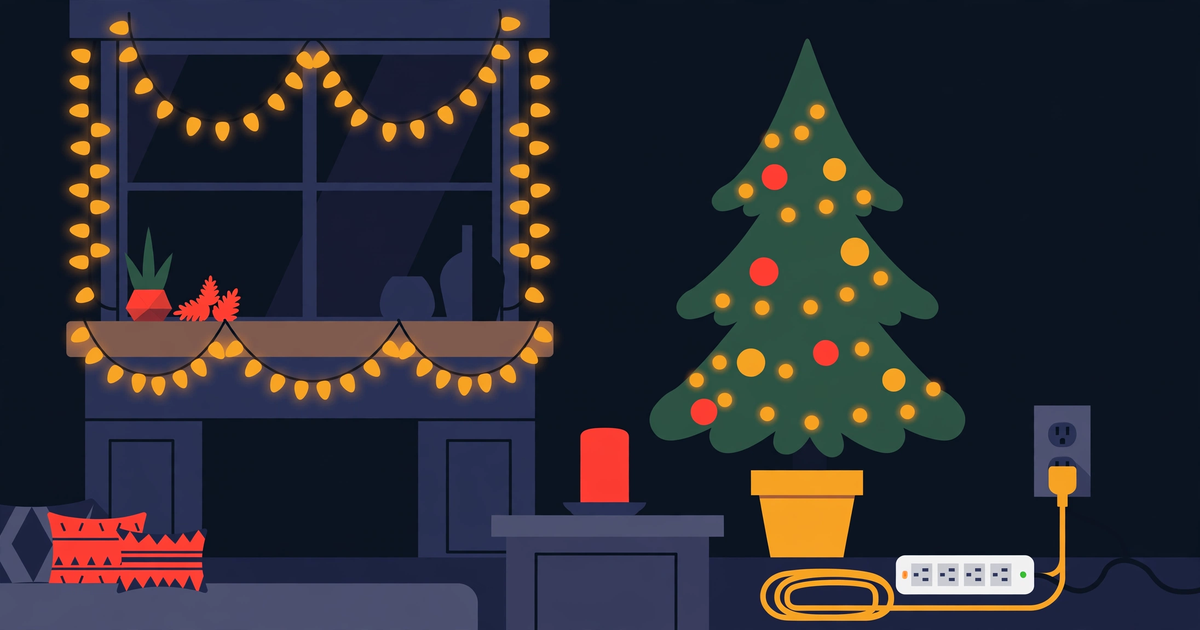
The same thinking applies to the outlet itself. A power strip creates more places to plug things in; it does not create more circuit capacity. Do not plug power strips into other power strips, and do not plug extension cords into other extension cords — chained cords overheat. Extension cords are temporary wiring: use one properly rated cord that is long enough for the job, never run cords under rugs or through walls, windows and doors, where they get pinched, damaged and hot without anyone seeing it. And never run a heater or a fan off an extension cord or power strip.
Learn the warning signs, because the house will tell you before it catches fire. A warm outlet, a breaker that keeps tripping, lights that flicker or dim when something else switches on, buzzing, crackling or sizzling sounds, discoloration around a socket, or a burning smell — any one of these means stop, unplug, and treat it as an electrical fault. Do not work around it with another adapter.
Outside: rain, cords and the GFCI
Outdoor lights live in a different world from indoor ones, and the rules change with it. Use only lights and extension cords rated for outdoor use outside, and plug them into GFCI-protected outlets — the ground-fault interrupters that cut the current the moment moisture or a damaged cord creates an imbalance. Keep connections off the ground and away from standing water, and never raise a ladder or a light string within 10 feet of overhead power lines. Cold-weather heating brings its own risks too — see our winter fire safety checklist and gas heater safety guide.
The tree: water, distance and lights off
If your festival includes a real tree, the NFPA's rules are short and non-negotiable. Choose a fresh tree — green needles that do not fall off when you touch them — and cut 2 inches (5 cm) from the base of the trunk immediately before putting it in the stand, so it can still draw water. Keep the stand filled with water at all times and add water daily; a tree can drink a surprising amount in its first week, and a dry tree is the one that burns. Remove it after the festival or as soon as it dries out — brittle needles that fall easily mean it is done.
Placement matters as much as watering. Keep the tree at least 3 feet (about 1 metre) from any heat source — fireplace, radiator, space heater, candle, heat vent — and never where it blocks an exit. Use only listed lights, replace any string with worn or broken cords, and turn the tree lights off before leaving the house or going to bed. Never put lit candles on a tree, and never go near it with an open flame. The same keep-your-distance rule applies to open flames outdoors — see our Bonfire Night guide.
Candles: the oldest light, the newest risk
Candles cause more decoration fires than the lights do, and the rules for them are the simplest in this whole guide. The U.S. Fire Administration's guidance: keep candles at least 12 inches (30 cm) from anything that can burn, in sturdy holders where they cannot be knocked over, and never leave a burning candle unattended — not for a quick errand, not while you sleep. Keep them away from curtains, decorations and the tree, and out of reach of children and pets. More than a third of home decoration fires are started by candles, and more than 40% happen because decorations were placed too close to a heat source. Battery-operated flameless candles give you the glow without any of it. And if someone collapses, our hands-only CPR guide explains what any bystander can do while help is on its way.
What our records show, and what they miss
Our articles archive and today's incidents record house fires the way they record every disaster: the address, the damage, the outcome filed. What they show is how ordinary the setting is — a living room on a festival night. What they miss is what nobody reports: the strand thrown away because its insulation was cracked, the warm outlet left alone, the tree watered every morning, the candles blown out before bed. Nobody files a report for the celebration that ended with the lights switched off and everyone asleep — and that is the whole point of the checks above. For other seasonal hazards, see our tornado safety guide.
The short version
- Inspect every light set and cord before use; throw away anything frayed, cracked or flickering, and buy only listed lights.
- Never connect more than three incandescent strings together; never daisy-chain power strips or extension cords; a warm outlet or tripping breaker means stop.
- Outdoors: outdoor-rated lights and cords only, on GFCI-protected outlets, connections off the ground, 10 feet from power lines.
- Real tree: cut 2 inches from the base, water daily, keep 3 feet from heat, never block an exit, lights off before bed or leaving home, no candles on it.
- Candles: 12 inches from anything that can burn, sturdy holders, never unattended — or use flameless candles.
- Test your smoke alarms before the festival starts.