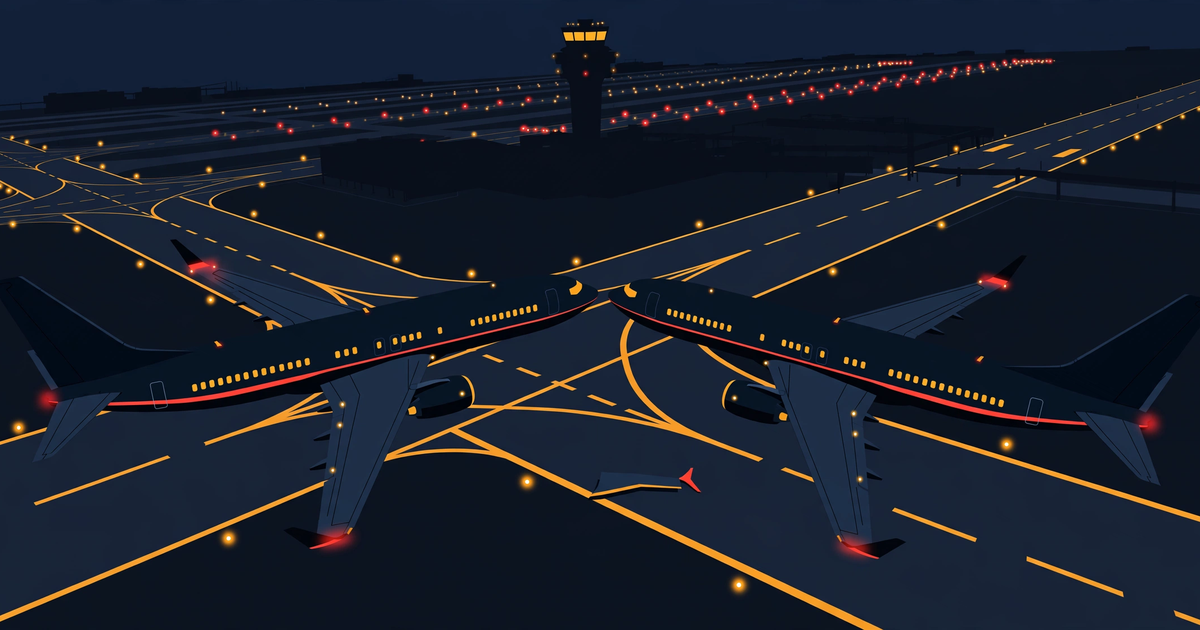
The Reagan National Airport wing clip
Two American Airlines Boeing 737s clipped wings while taxiing for departure at Ronald Reagan Washington National Airport on Friday, 27 November 2026. The contact happened at about 5:10 p.m. Eastern time, near Runway 19, according to the Federal Aviation Administration. Nobody was hurt. The FAA said it will investigate, and both aircraft were taken out of service for inspection.
The two flights were heading in different directions. Flight 638 was bound for Dallas-Fort Worth, and Flight 2152 was bound for Chicago, according to CNN. Air traffic control audio captured the Dallas-bound pilot reporting that his aircraft was slightly over the hold short line and that the two planes had swapped paint. A winglet, the upturned tip at the end of a wing, was sheared off one of the jets, and debris was left on the ground. The tower told an arriving aircraft to abandon its landing while the debris was recovered.
What the tower, the airline and the FAA have confirmed
The airport authority's fire and rescue department checked both aircraft after they reached the gate, and American Airlines said the planes would be inspected by its maintenance teams. The airline apologised to passengers and said they would depart on later flights on Friday evening. CBS News reported that there were no disruptions to other flights, and that the FAA will investigate.
The timing added to the pressure. About six million Americans were projected to fly domestically during the Thanksgiving holiday, according to AAA, cited by CNN. The same week had already brought storm disruption to travel on both coasts, which we covered in our Thanksgiving storm report, and a nationwide ground stop two weeks earlier, covered in our FAA ground stop article. A busy airport and a holiday weekend leave a small error less room to absorb.
What a winglet is, and why losing one grounds a plane
A winglet is the short, upturned fin at the very tip of a wing. It cuts drag and saves fuel, and on a 737 it is the widest point of the aircraft when it is on the ground. That is why winglets are so often the first thing to touch when two aircraft pass too closely on a taxiway. Losing one is not cosmetic. The aircraft cannot simply carry on to Dallas or Chicago with a piece of its wing missing. It has to be inspected, and the part repaired or replaced, before the jet flies again. Debris on a taxiway is a hazard in itself, which is why the tower held an arriving flight until it was cleared.
Why this airport, and why this week
Reagan National is a tight airport. It has three runways, and CBS News describes it as one of the busiest in the nation, operating in tightly restricted airspace near the White House and the Capitol. Short taxiways, closely spaced stands and a lot of movements in a small footprint leave little margin.
The airport's name also carries a weight that no other US airport does. In January 2025, an American Airlines regional jet and a US Army helicopter collided in midair over the Potomac as the jet was approaching to land, killing all 64 people aboard the jet and the three soldiers on the helicopter, according to CBS News. In January 2026 the National Transportation Safety Board published its final report, making 74 findings and 50 safety recommendations, 33 of them to the FAA, and concluding that systemic failures in airspace design, oversight and risk management had allowed the danger to build. Friday's wing clip was a different kind of event, at low speed, on the ground, with no injuries, and should not be read as a repeat of January 2025.
Ground collisions keep happening, and that is the point
Friday's clip was not a one-off. Earlier in November, at Miami International Airport, a Copa Airlines 737's wingtip struck the nose of a UPS 767, and two passengers suffered minor injuries. We covered that incident in our Miami ground collision report, and the FAA is investigating it too. In early October, a Delta wingtip clipped an Air Canada tail at Los Angeles International Airport, with no injuries reported, according to CBS News.
Ground collisions share a pattern. They happen at low speed, in places where aircraft are close together and moving on instructions from the tower. The margin is measured in feet, and the person at the controls cannot always see the wingtip from the cockpit. That is why the FAA calls runway safety one of its highest priorities and works to reduce runway incursions, the term for an aircraft, vehicle or person wrongly entering a runway or taxiway area.
What happens next, and what passengers should do
The FAA investigation will look at the air traffic control recordings, the positions of both aircraft, the taxiway layout and the hold short line the Dallas-bound pilot mentioned. That work takes time, and the early reports will not contain a cause. Anyone who tells you today exactly who was at fault is guessing. The useful questions are where each aircraft stopped, and what instructions each crew had received.
If you were on one of the two flights, the practical advice is simple. Stay seated with your belt fastened until the crew tell you otherwise, even when the aircraft is only taxiing. Expect a delay while the aircraft is checked and a new flight is arranged, and check your flight status before travelling if you are due through Reagan National this weekend. Our US Airport Delays tool tracks delays across the country, and our Air Crash records list the aviation incidents we have verified.
What our records show, and what they miss
Our records show a cluster, not a verdict. In November alone we have logged a ground collision at Miami, a nationwide FAA ground stop, a Thanksgiving week of storm disruption and a fatal small-plane crash off Horn Island, Mississippi, covered in our Horn Island report. The pattern that stands out is not one cause. It is pressure: busy airports, holiday traffic, weather and a system absorbing one disruption after another.
What our records miss is just as important. We do not yet know why Flight 638 stopped where it did, or whether the other aircraft was exactly where it was supposed to be. We do not have the FAA's findings, and we do not have the data that would turn a handful of headline incidents into a rate, such as aircraft movement figures for each airport. Until the investigation reports, the honest position is that two aircraft touched at low speed, nobody was hurt, and the system that is supposed to keep that from happening is being asked, again, to explain itself.
The short version
- Two American Airlines Boeing 737s clipped wings while taxiing at Reagan National Airport on Friday, 27 November 2026, at about 5:10 p.m. Eastern time. Nobody was hurt.
- Flight 638 was bound for Dallas-Fort Worth and Flight 2152 for Chicago. A winglet was sheared off, debris was cleared, and both jets were taken out of service.
- The FAA said it will investigate. The cause is not yet known, and early speculation about blame should be ignored.
- The incident follows the January 2025 midair collision at the same airport, in which 67 people were killed, and the NTSB's January 2026 report, but a low-speed taxiway clip is a different kind of event.
- Passengers should stay seated until the crew say otherwise, expect rebooking delays, and check flight status before travelling through Reagan National this weekend.