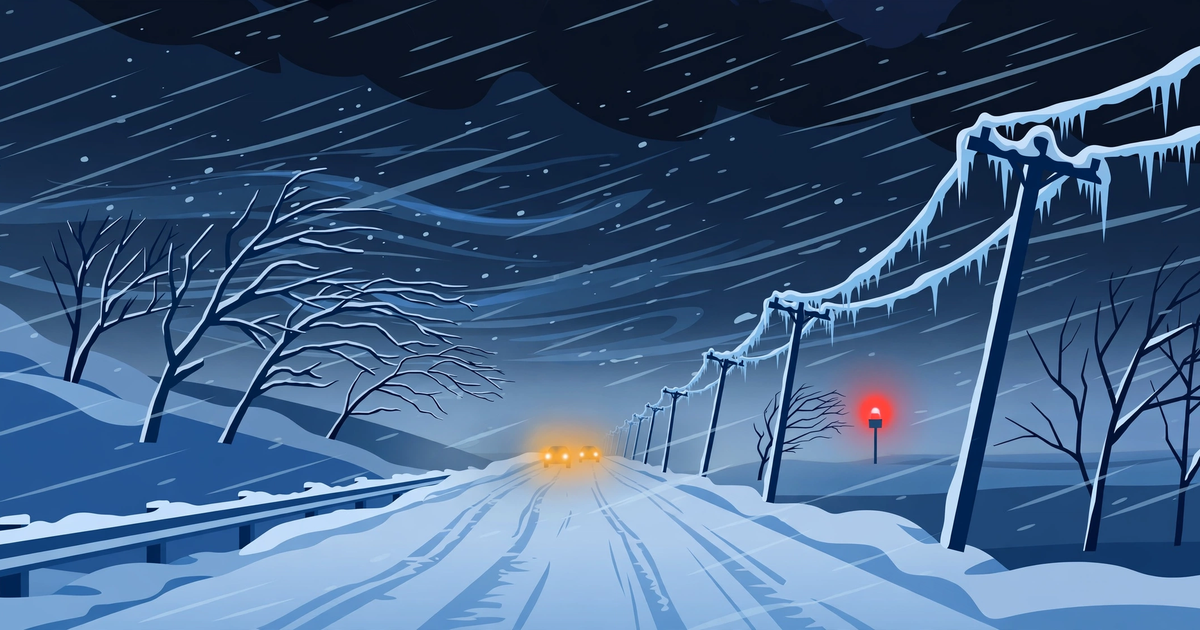
The Thanksgiving winter storm 2026 did not arrive as a single event. Two storms worked their way across the United States during the busiest travel week of the year, dumping snow on the Midwest, flooding coastal towns in the Northeast, and cutting power to millions of homes. By Sunday morning, hundreds of thousands of people were still waiting for the lights to come back on.
How the Thanksgiving winter storm 2026 unfolded
The first storm pushed into the central United States on Tuesday 25 November, spreading snow, sleet and ice across Missouri, Illinois and Kentucky. A second system, a nor'easter, then raked the East Coast with heavy rain, strong winds and coastal flooding in New Jersey and Pennsylvania, while a separate winter storm kept building over Colorado.
Forecasters had seen the shape of the week coming, and the warnings went out early. What nobody could say in advance was how long the power would stay out. In the end the storm did not have one worst-hit town. It had a dozen of them, scattered from Missouri to the Atlantic coast, and the outages piled up faster than crews could clear them.
Snow totals: Missouri took the heaviest fall
The deepest snow fell in south-east Missouri. According to the National Weather Service office in Paducah, Kentucky, Perryville in Perry County recorded 11.0 inches, the highest total in its storm reports, with 10 inches reported by the county emergency manager and 10 inches at Patton in neighbouring Bollinger County. Across south-east Missouri the totals ran from 4 to 11 inches, with 1 to 4 inches in far south-west Illinois and far south-west Kentucky.
Those numbers came with the usual mess on the roads. The weather service's reports describe snow-covered and slippery roads across the region, cars sliding off the road around Perryville on the night of 25 November, and power reported out in the Piedmont area as the snow piled up.
Further west, the storm was still gathering strength. The Denver Post reported that Denver was bracing for up to 18 inches of snow with gusts of 55 to 65 mph, and 9News put the expected totals at 18 to 20 inches. Thousands of customers lost power in Colorado as the storm moved in, according to Denver7 and FOX 31.
Power outages stretched into the weekend
The outages were the story of the week. Axios reported millions of customers without power as the Thanksgiving storms wreaked havoc, and NBC reported that more than 700,000 customers were still without power early on Friday. The numbers fell slowly: the New York Times reported on Sunday that thousands remained without power, and a round-up of outage data the same day put the figure at hundreds of thousands of customers still in the dark across the US coasts.
In the St Louis area the wait was measured in days, not hours. KSDK reported that at least 29,000 Ameren Missouri customers were still without power on Saturday morning, and the figure barely moved through the day. For the families affected, that meant a Thanksgiving weekend without heating, without refrigeration and without a way to charge a phone — in late November, with temperatures falling after the storm.
A parade postponed, a roof collapsed
The most visible casualty of the week was the Macy's Thanksgiving Day Parade. It was postponed by a day, the first postponement in the parade's history, and finally marched through New York on Friday 28 November for its 100th outing. NPR reported that marching bands caught by the delay had to fundraise to stay in the city an extra night.
Closer to the snow, the damage was heavier. The roof of the Wentzville Ice Arena collapsed under the weight of the storm, and the arena closed indefinitely. The World Bird Sanctuary, near St Louis, reported what it called unprecedented and catastrophic damage and closed temporarily, and Tower Grove Park closed after trees came down across its grounds.
Flooding on both coasts
While the Midwest dug out of the snow, the coasts dealt with water. CBS reported record high tides on both the Atlantic and Pacific coasts, and the nor'easter pushed flooding into New Jersey and Philadelphia. The Independent reported that the clean-up was beginning for millions of people affected by severe winter storms, with flooding reported across the country.
What to do if the power is still out
If your home is still without power, the first rule is to stay warm without creating a new danger. Never run a generator indoors, in a garage or near an open window, and never use a gas stove or oven to heat a room. Carbon monoxide has no smell and no colour, and it kills quietly. Our guide to carbon monoxide safety at home explains the warning signs and what to do if an alarm sounds.
A few practical steps make the wait easier:
- Keep fridge and freezer doors closed. Food stays safe for about four hours in a fridge and about 48 hours in a full freezer, as long as the doors stay shut.
- Use torches, not candles. A candle left burning in a dark house is a fire risk, and fire crews are already stretched during a storm. Check that your smoke alarms are working while you are at it.
- Check on older neighbours. A short visit or a phone call is often the fastest way to find out who needs help.
- Report the outage to your utility. Outage maps are built from customer reports, and an unreported outage is an outage nobody is coming to fix.
- Stay off the roads if you can. Ploughs and repair crews need clear roads, and a car stuck in a snowdrift is one more job for the people already working through the night.
What our records show, and what they miss
Our records show the week building up before it hit. We covered the forecast while the two storms were still closing in, and we covered the freezing rain that coated roads and power lines in Ontario on 26 November. The pattern is familiar: a winter storm that looks manageable on a forecast map, and then turns into a week of outages once it meets real houses, real trees and real power lines.
What our records miss is the speed at which the picture changes. Outage figures move by the hour, and the numbers in this article were already a day old in places by the time they were published. They also miss the local detail: which streets are still dark and which roads are still closed. For that, the local utility outage map and the county emergency management page will always be more useful than any national article, including this one.
The same week brought two other stories we covered separately: a magnitude 5.0 earthquake off Manhattan Beach that rattled Los Angeles on Saturday, and the El Niño floods in Ecuador that have now killed at least 34 people.
The short version
- Two storms hit the United States over Thanksgiving week, 25-28 November, bringing heavy snow to the Midwest and flooding to the East Coast.
- Millions of customers lost power at the peak, according to Axios; more than 700,000 were still out early on Friday, according to NBC, and hundreds of thousands remained out on Sunday.
- The heaviest snow fell in south-east Missouri, where Perryville recorded 11 inches, according to the National Weather Service in Paducah.
- The Macy's Thanksgiving Day Parade was postponed by a day for the first time in its history, and the Wentzville Ice Arena roof collapsed under the snow.
- If your power is still out, never run a generator indoors, keep fridge doors closed, and report the outage to your utility.