You cannot tell by looking
An ankle twists on a step. A wrist takes the weight of a fall. In the first minutes, a sprain, a strain and a fracture can look almost identical: pain, swelling, bruising, and a limb the person does not want to move. The British Red Cross is blunt about this — it is usually impossible to tell a broken bone from a sprain or strain without an X-ray.
That uncertainty is not a reason to do nothing. It is the reason the first aid is the same either way: treat the injury as the more serious one until a professional says otherwise. St John Ambulance puts it as a standing rule — if in doubt, always treat it as a fracture.
A sprain is damage to a ligament at a joint; a strain is damage to a muscle or tendon; a fracture is a break, chip or crack in a bone. The names matter less than the response: stop, support, cool, and get the person assessed.
First: stop, and keep it still
The first thing is rest — for the person and for the injured part. Have the person stop, sit or lie down somewhere safe, and put no weight on the injury. Do not ask them to test it, walk on it, or move it to see whether it is broken: rest without moving or straightening the injured part.
If they fell from a height, were hit hard, or hurt their head, neck or back as well, do not move them at all unless they are in immediate danger — a suspected spine injury means keeping them exactly where they are and calling for emergency help. Heavy bleeding from an open wound comes first: press around the wound, and get help.
Support the injury in the position you found it — with the person's own hand, or with a cushion or folded clothing, above and below the injury if you can. Padding around the limb adds support without forcing anything into a new position. The point is stillness, not alignment.
Sprains, strains and fractures first aid: RICE, the four letters to remember
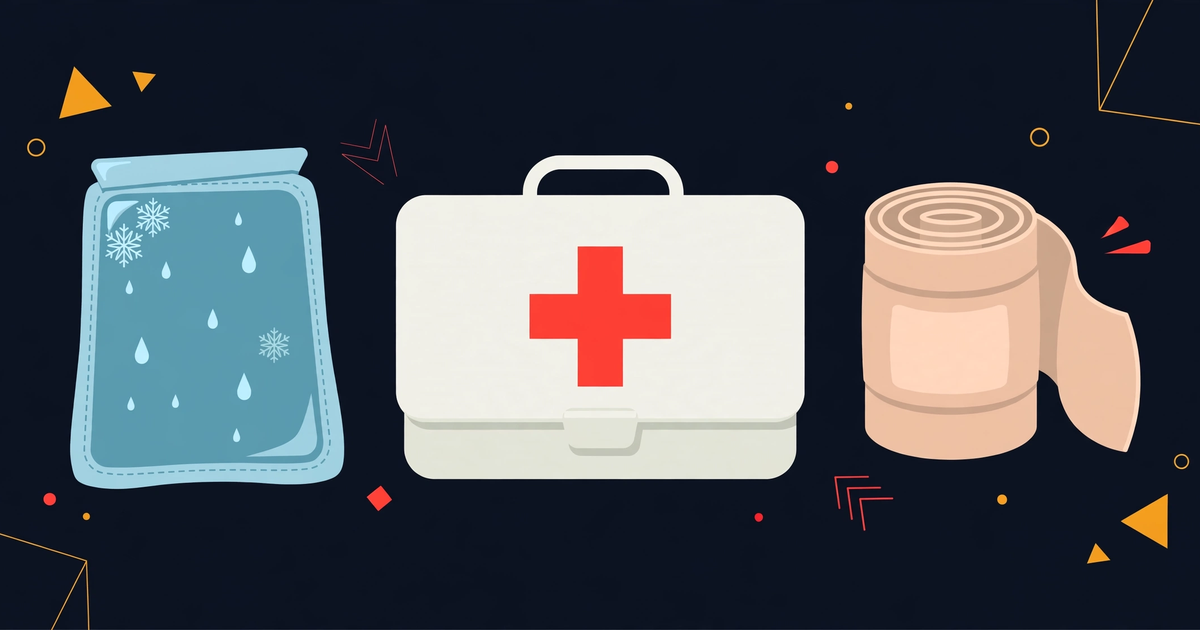
For a sprain or strain, first-aid guidance is remembered by four letters: RICE — Rest, Ice (or Cool), Compression (or Comfortable support), Elevate.
Rest. Stop the activity and rest the injured part. No weight on it, no testing it, no "walk it off".
Ice — or cool. Apply a cold pack to reduce swelling and pain, wrapped in a cloth first — never put ice directly on bare skin, and never rub it on the injury. Keep applications short and take the pack off if it causes discomfort. Sources disagree on the exact minutes, so this guide quotes none: short, wrapped, and off if it hurts.
Compression — comfortable support. A bandage around the injury can support it and limit swelling, applied firmly and extending well beyond the injury on both sides. It should not be tightly wrapped, and must not become tight: if fingers or toes beyond it turn pale, blue or cold, or go numb, loosen it at once.
Elevate. Keep the injured part supported in a raised position, above heart level if you can do it without causing pain. Do not raise it if moving it causes pain: comfort and stillness come first.
What not to do in the first days
St John Ambulance adds a second memory aid for the days after the injury: avoid HARM. Heat, Alcohol, Running or other exercise of the injured area, and Massage. Heat in the first days can increase swelling, and alcohol, exercise and massage all push blood and movement into tissue that needs the opposite.
Do not test the injury to prove it is fine. Rest is not doing nothing; rest is the treatment.
If it might be broken: support, do not straighten
Signs a bone may be broken: a lot of pain, a limb in an unnatural position after a fall or blow, visible deformity, a grating feeling, or an inability to move or use the limb. Any of those means the same response: support it, keep it still, and get the person to hospital.
Never try to straighten a deformed limb, push a bone back into place, or put a dislocated joint back. Forcing a limb can damage nerves, blood vessels and soft tissue, and can turn a closed fracture into an open one. Medical professionals will take care of realignment; your job is to hold the injury exactly as you found it.
If bone has come through the skin — an open fracture — cover the wound with a clean, non-fluffy cloth and press around it, not over the protruding bone, to control bleeding. Secure the dressing and call for emergency help at once; the person should not eat or drink in case surgery is needed.
Splinting is for one situation only: when you must move the person, or when help will be delayed. Splint in the position found, using a rigid item such as a board or rolled-up newspaper, secured above and below the fracture — not tied too tightly. If you are not sure how to splint safely, support the limb with cushions and wait for help.
When to call for emergency help
Most sprains and strains can be taken to hospital or a clinic with help from family. But call your local emergency number now if the person cannot move or is in a lot of pain, the limb is badly deformed, there is an open wound or bone visible, severe bleeding, or the limb beyond the injury is pale, blue, cold or numb. Call at once, too, if the head, neck, back, hip or pelvis may be involved, or if the person shows signs of shock, such as pale, cold or clammy skin.
Do not move a casualty with a suspected back, neck or pelvis injury unless they are in immediate danger. Keep them still and warm until help arrives.
When help arrives, tell the responders what happened and what you did. Even a mild-looking sprain deserves a professional look if the pain does not settle, the person cannot bear weight on it, or swelling keeps getting worse.
What our records show, and what they miss
Our records log sprains, strains and fractures as they are reported, alongside the other incidents on the live map and in today's incidents. What they show is where and when these injuries happen; what they miss is the first aid that followed — the rest, the cold pack, the support and the call for help. That is why this guide relies on the Red Cross and St John Ambulance, and sits alongside our hands-only CPR, choking first aid and burns and scalds guides, in articles and reports.
The short version
- You cannot tell a sprain, a strain or a fracture apart without an X-ray — if in doubt, treat it as a fracture.
- Rest the person and the injured part; do not move it, test it or straighten it.
- Cool with a cold pack wrapped in a cloth, for short periods, never directly on bare skin; support with a comfortable bandage, not too tight, and elevate above heart level if it does not cause pain.
- Splint only if you must move the person or help will be delayed — in the position found, secured above and below; never try to put a dislocated joint back or push exposed bone back in.
- Avoid heat, alcohol, running and massage in the first days; call emergency services if the person cannot move, is in a lot of pain, the limb is deformed, there is an open wound, or the head, neck, back, hip or pelvis may be involved.