Wildfire evacuation: leave early — that is the whole plan
Wildfire evacuation starts with one rule: leave early. A wildfire gives you minutes, not hours, and the fire does not wait while you decide what to take, argue about which road to use, or stand in the yard watching the smoke to judge how close it is. The American Red Cross is blunt about the one rule that matters most: if an emergency threatens your neighbourhood, be prepared to evacuate quickly, and leave the area if local officials tell you to do so.
Leave early, and leave on the order — not on the flames. The Red Cross adds the part people forget: you might not get an official notice to evacuate. Be ready to leave if local authorities advise it, or if you feel you are in danger. Waiting to see flames before you move is waiting too long.
Ready: decide where you will go
The Ready, Set, Go approach used by fire services starts with Ready: prepare now, while there is no smoke. The first decision is where you will go. The Red Cross asks every household to answer three questions in advance: where will you go, how will you get there, and where will you stay? A relative's house, a friend outside the fire area, a hotel, a public shelter — pick one, and pick a second in case the first is in the fire's path too.
Tell the people at both places that they are your plan. Save their addresses and phone numbers on paper as well as on your phone, and make sure everyone in the household knows the plan — including children old enough to understand it.
Sign up for free emergency alerts from your local government — during a wildfire, the most important information comes from local government.
Set: know two ways out
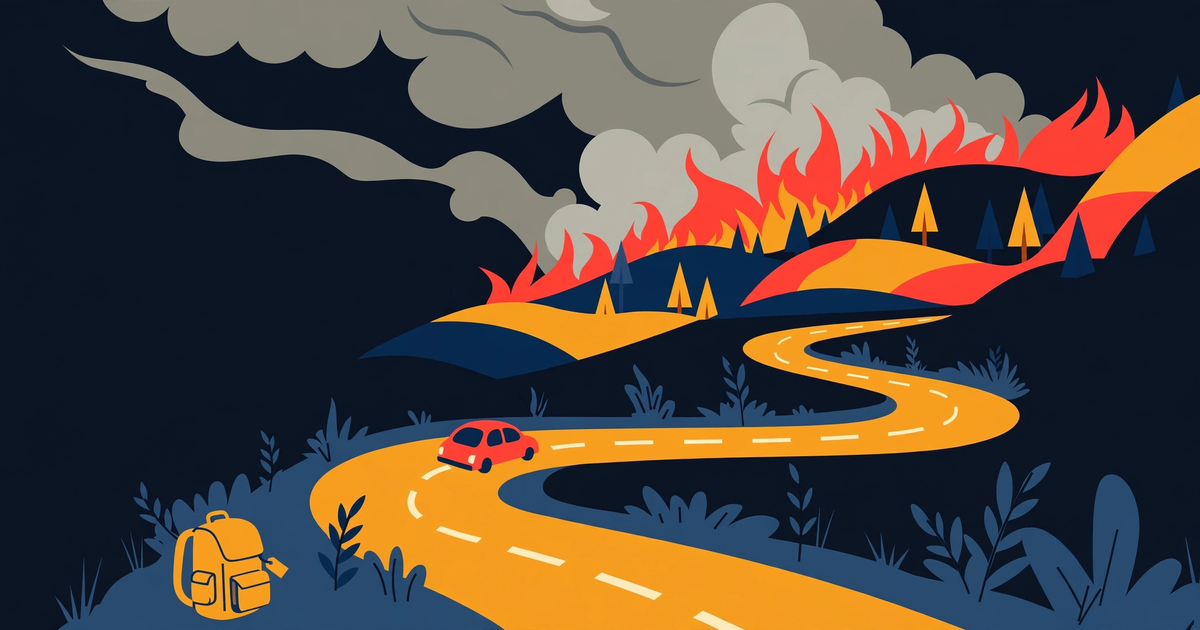
Know different escape routes from your home and community, and practise them so everyone in your household is familiar with them. That is the Red Cross instruction, and it has a reason: the road you use every day may be the road the fire closes first. A fallen tree, a traffic jam, a fire crew coming the other way — any of them can shut your first route, and a family that has only ever driven one way out will waste its best minutes working out another.
Mark two routes on a printed map and keep it in the car and in the go-bag. The Red Cross specifically recommends a printed map, in case GPS is not working or you have to look for an alternate route. Phone signal and sat-nav both fail in a fire area — batteries die, towers burn, and the map on your dashboard is the one that still works when the screen goes dark.
During fire season, keep the car's fuel tank at least half full and park facing out, so you can leave without reversing into a street full of smoke.
The go-bag by the door
Gather your supplies in advance, because stores and pharmacies might be closed when a fire comes. The Red Cross organises supplies into two kits: a Go-Kit of 3 days of supplies that you can easily carry with you, and a Stay-at-Home Kit of 2 weeks of supplies if you need to stay at home. The go-bag is the one this guide is about, and it lives by the door.
Food and water for three days, and medicine — extra medicine, in its original packaging, with a list of what each person takes. Important documents: personal, financial and medical records, proof of address, insurance policies, passports and birth certificates — hard copies, or securely backed up.
Take your pets with you — never leave them behind. Their food and water, a leash and a carrier, and any medicine they need go in the bag with yours. The pet go-bag guide on this site covers the full list; the point here is the decision, made now: the animals leave with the family, in the same car, at the same time.
Go: when you are told, leave immediately
When the order comes, leave immediately. Do not delay to gather belongings or make efforts to protect your home — that is the instruction at the Go stage, and it is written that way because people die doing the opposite. The house can be rebuilt. The photo album you went back for cannot be carried out through a road that has already closed.
Grab your emergency go-kit and follow the evacuation routes. Do not try to take shortcuts, the Red Cross warns, because they may be blocked. The signed route is the route the fire crews know about and the route the traffic is being sent down. A shortcut through a side road can lead straight into the fire, or into a dead end with no way to turn around.
If you are trapped
It can happen even to a family that left early: the road closes behind and ahead, and there is nowhere to drive. If you are trapped in a car, park in an area clear of vegetation, close the windows and vents, and lie low — below the window line, covered with a blanket or a coat if you have one. Stay in the car. It gives more protection than running through smoke and heat on foot, and it is where rescuers will look for you.
Call your local emergency number if you can, tell them where you are, and stay on the line if they ask you to.
After: do not go back until you are told
Wait for officials to say it is safe before going back home. That is the Red Cross instruction, and it is not a suggestion. A fire that looks out can still be burning underground, in root systems and in smouldering debris, and a street that looks clear can have fallen power lines, unstable trees and pockets of heat in the ground.
When you are allowed back, go carefully. Watch for hot ash, charred trees that may fall, smouldering debris, and heat pockets in the ground — all hazards the official guidance lists for returning residents.
What our records show, and what they miss
Our incident records log the fires, the roads closed and the homes lost — but they almost never record whether the family had a plan before the smoke arrived. The records show the evacuation; they miss the decision made weeks earlier, the second route practised, and the bag by the door that turned minutes into a safe exit.
The short version
- Leave early: go when officials tell you to, and be ready to leave even without an official notice if you feel in danger.
- Decide before fire season where you will go, how you will get there, and where you will stay — and a second place in case the first is in the fire's path.
- Know different escape routes from your home and community, practise them, and carry a printed map in case GPS fails.
- Keep a Go-Kit by the door: 3 days of food, water and medicine, important documents, a torch, a phone charger, and the printed map.
- Take your pets with you — never leave them behind.
- Keep the car's fuel tank at least half full in fire season and park facing out.
- When told to leave, leave immediately — do not delay to gather belongings or protect your home; follow the evacuation routes and take no shortcuts.
- If trapped in a car, park clear of vegetation, close windows and vents, and lie low; stay in the car.
- Do not return home until officials say it is safe — and watch for hot ash, charred trees, smouldering debris and heat pockets in the ground.